
1-805-484-2992
Quotes - Engineering - Sales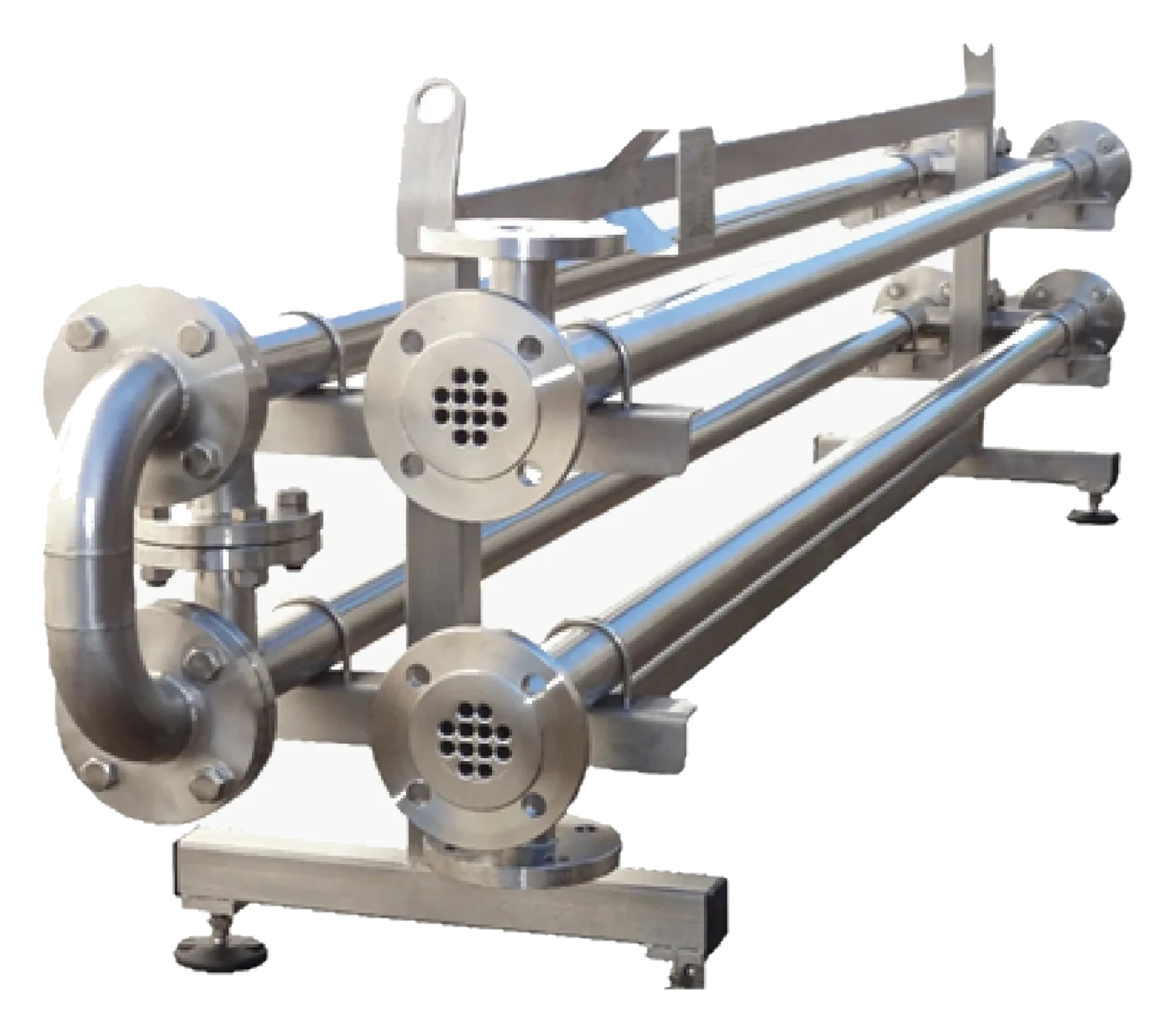
Built for the Product a Plate Pack Cannot Take
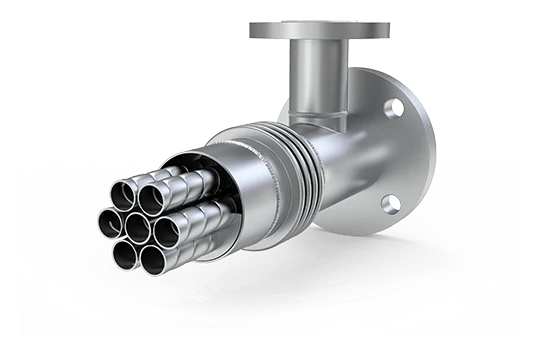
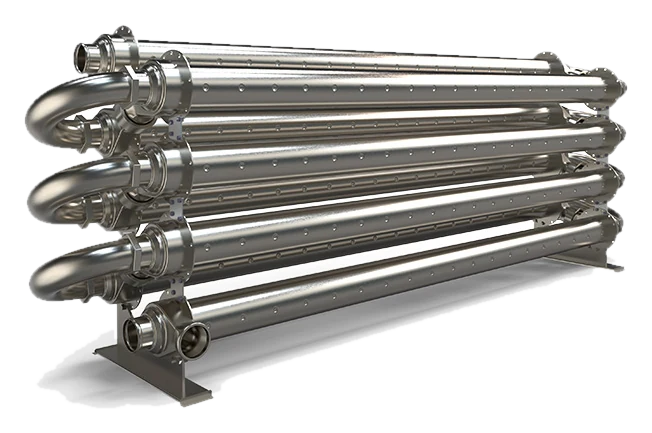
A tube-in-tube heat exchanger puts the product in a plain round tube and the heating or cooling medium in the jacket around it. Sections join with U-bend returns into a hairpin bank, and the length of that bank is what sizes the duty. No plates touch each other, welded builds carry no gaskets in the product path, and there is no corner where a fiber can catch. A pulpy juice, a sauce with diced vegetables or a mining slurry leaves through the same open bore it entered.
Most buyers arrive here holding one stubborn stream rather than a part number. A plate exchanger that bridged with pulp two hours into the run. A shell-and-tube whose tubesheet face scaled over between cleanings. A product sized on a viscosity measured at room temperature that then refused to move at the cooling outlet. Tube-in-tube answers those failures with wide channels, true counterflow and pressures that round tubes carry comfortably, to 1500+ psi in industrial double pipe builds.
It is not the answer to every duty. For a clean, water-thin fluid at modest pressure, a plate exchanger is usually the cheaper buy, and a very large clean duty usually favors shell-and-tube on cost per square foot of surface. Tube-in-tube earns its floor space where the product is thick, carries pieces, fouls, attacks ordinary steel or runs hot and at high pressure. Tell us what the stream is and we will say plainly which side of that line it falls on.
Built to Code




Sized From Real Data
We Size It From Your Fluid, Not a Guess
Viscosity drives almost every tube-in-tube sizing, and it is the number most often wrong on a data sheet. Ketchup, mayonnaise and tomato paste run from thousands to tens of thousands of cP, thin out under shear and thicken sharply as they cool. A figure taken at one temperature and one shear rate can leave an exchanger short by whole sections. Where the data is thin, we test a sample: viscosity, rheology, and a reverse sweep for products that change with time under shear.
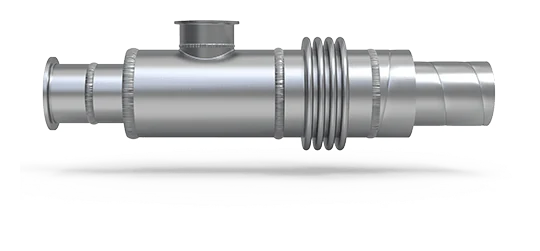
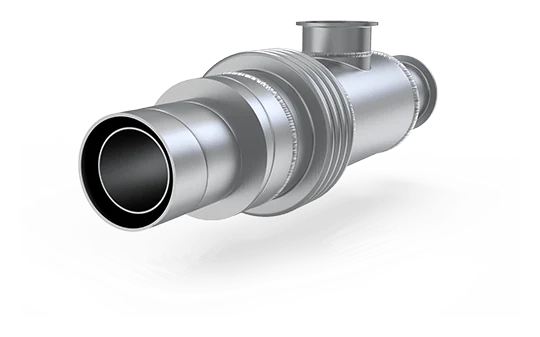
With measured behavior in hand, we match the geometry to the product: a single bore for intact pieces, multi-tube for smooth or fine-particle fluids, triple-tube for very heavy product, double pipe for high pressure and Ultra-Coil where floor space is short and the approach is close. Sanitary units come in 316L with tri-clamp ends to 3-A; industrial units run from carbon steel through 2205 duplex, AL-6XN, titanium and high-nickel alloys.
Where to Start

Tube-in-Tube
Sanitary
316L or 304L, polished or electropolished, tri-clamp ends, built to 3-A and fully drainable for sauces, purees, pulpy juices and creams.
+ Learn More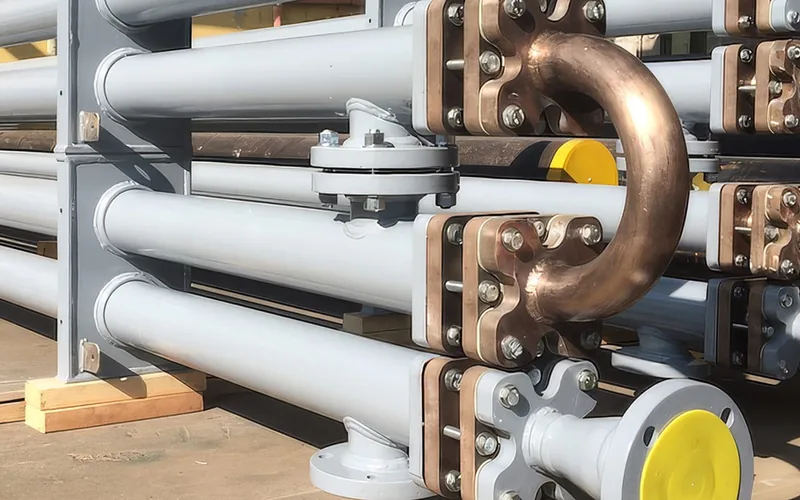
Tube-in-Tube
Industrial
Carbon steel to titanium and high-nickel alloys, flanged or threaded, for slurries, sludge, crude and corrosive streams to 1500+ psi.
+ Learn More
Tube-in-Tube
Sizing & Selection
Viscosity, rheology and reverse-sweep testing on your sample, then a design sized on measured data and built to the codes you need.
+ Learn More
