
1-805-484-2992
Quotes - Engineering - SalesThick products change the rules of sizing
Laminar flow, weak film coefficients and the pump as the real limit
Water-like fluids cross a tube in turbulent flow, and the film at the wall stays thin. A product at several thousand cP does not behave that way. Below a Reynolds number of about 2,100 the flow is laminar, the velocity profile turns parabolic, and the slow layer against the wall becomes the main resistance to heat transfer. The product-side film coefficient can drop to a small fraction of what water gives in the same tube, so a viscous duty needs far more length than an equal heat load on a thin fluid.
Length costs pressure. In laminar flow, pressure drop climbs in direct proportion to viscosity and to tube length, so every section added for heat transfer also adds load on the pump. On most viscous duties the allowable pressure drop, not the surface area, decides the tube diameter, the number of parallel paths and the final layout. A design that skips this check looks fine on paper and stalls on the first cold start.
Tube-in-tube suits these products because the channel is round, open and free of contact points. Welded designs keep gaskets out of the product path, shear stays low and predictable, and the bore can be chosen to balance film coefficient against pressure drop. Sanitary units in 316L carry the food, cosmetic and pharmaceutical products in this section; heavy industrial resins and oils sit in the Industrial menu.
Request a Quote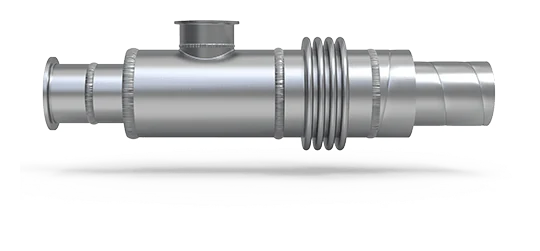
The viscosity a non-Newtonian product shows at one particular shear rate and temperature - the figure a designer needs at the conditions next to the tube wall, not at a lab default.
Viscous products and the page for each
Each product group behaves differently in a tube. Pick the one closest to your product for its design points, material notes and the mistakes we see most often.
| PRODUCT GROUP | TYPICAL BEHAVIOR | WHAT DRIVES THE DESIGN |
| Thick sauces and condiments | Shear-thinning, thousands of cP | Pressure drop at the cool end, plus triple-tube or corrugated surface to lift the film coefficient. |
| Salad dressings | Oil-in-water emulsions | Wall shear in tubes and fittings, cooling straight after the mixer, acidity and herb or spice pieces. |
| Sweeteners and sugars | Very thick when cool | Viscosity that rises steeply as syrup cools, crystals forming on a cold wall, and Brix-dependent properties. |
| Cosmetics and personal care | Creams, lotions, gels | Gentle cooling after emulsification, heavy product at fill temperature, and sanitary cleaning between batches. |
| Pastes and heavy fillings | Slow, dense product | Heating or cooling from both sides of a thin annulus to cut the length one tube would need. |
Why a tested sample beats a datasheet viscosity
Many viscous products are shear-thinning: their viscosity falls as the shear rate rises. A sauce or lotion quoted at one value from a spindle viscometer may be several times thicker or thinner at the wall shear rate inside a tube. Temperature moves it further, and for many foods the viscosity drops sharply on heating and climbs just as sharply on cooling. A single room-temperature number at an unknown shear rate is a common reason a viscous-product exchanger comes out too short, or ends up paired with a pump that cannot push it.
Testing a sample removes the guess. Viscosity is measured across the temperature range the product will actually see, rheology testing maps how it responds to shear, and a reverse sweep shows whether it thins while moving and slowly rebuilds at rest. That last behavior matters after a shutdown: product left standing in the tube overnight can need far more pressure to restart than the running figure suggests.
With measured curves in hand, sizing becomes a set of honest trade-offs. A larger bore lowers pressure drop but also the film coefficient; corrugation adds transfer but lowers the particle size the tube can pass; parallel paths add capacity but raise questions about how evenly product splits between them. We size the unit from your data and say plainly where the limit sits. Send the product, flow and temperatures, or ship a sample for testing.
Call and talk it through with an engineer: 1-805-484-2992
Heating a thick product
The wall is the hottest point the product touches, and in laminar flow the layer next to it moves slowest and stays longest. Starches, proteins and sugars burn on there first. Hot water in the annulus at a modest temperature difference is usually kinder than steam, even though it needs more length. Brown specks in the product and a creeping rise in pressure drop are the early signs of a wall that runs too hot.
Cooling a thick product
Viscosity rises as the product cools, so the outlet sections carry most of the pressure drop. Staged cooling, with tower water first and chilled water or glycol only for the last few degrees, saves the coldest coolant for product already close to its target. Fats, waxes and concentrated sugars can set or crystallize on a very cold surface, and that layer insulates the tube just when the duty needs it most.
Where corrugation helps
A corrugated tube disturbs the slow layer at the wall, which raises the film coefficient most in the laminar and transition range where viscous products live. The price is extra pressure drop and a lower limit on particle size. For smooth products with no pieces that must survive, corrugation can shorten a unit noticeably; for chunky or fibrous products a smooth full bore stays the safer choice.
Getting thick product out
A water push displaces most of the product before cleaning starts, and full drainability lets the rest leave by gravity. The CIP circuit must reach a cleaning velocity in every tube, which on a large viscous unit can mean more flow than the product itself ever runs at. Round tubes with no dead zones leave nothing hidden for the cleaning solution to miss.
Before sizing a viscous duty
Because the product runs laminar. In laminar flow the film coefficient on the product side is low and largely fixed by the tube diameter and the fluid's conductivity, so the only way to move the heat is more surface. On a tube-in-tube, more surface means more length, and that length is also where the pressure drop comes from.
For genuinely thick products, no. The velocity needed to push a product at thousands of cP past a Reynolds number of 2,100 would create a pressure drop far beyond any sanitary pump or tube rating. The design accepts laminar flow and improves it instead, with a smaller bore, corrugated tube or a triple-tube section that heats from both sides.
Only if it states the temperature and the shear rate, and the product is close to Newtonian. Most sauces, creams and gels are not. A sheet value taken at room temperature on a viscometer spindle can be wrong by several times at tube-wall conditions. When the number is uncertain, a sample test costs far less than an undersized exchanger.
Usually it does. Centrifugal pumps lose head and flow quickly as viscosity rises, while positive displacement pumps deliver steady flow against high pressure. We give you the exchanger pressure drop at running temperature and at the coldest likely start, so the pump and its relief setting are chosen against the real worst case rather than the normal one.
Related

Sanitary
Thick Sauces & Condiments
Tube-in-tube heat exchangers for ketchup, mustard, BBQ and cheese sauce and mayonnaise, sized on viscosity and pressure drop for hot fill and cooling.
+ Learn More
Sanitary
Salad Dressings
Tube-in-tube heat exchangers for salad dressings: low-shear cooling after the mixer, 316L for vinegar and salt, and herbs and spices passed intact.
+ Learn More
Sanitary
Sweeteners & Sugars
Tube-in-tube heat exchangers for honey, glucose and corn syrup, liquid sugar and molasses: heating to pump, cooling after evaporation, no crystal buildup.
+ Learn More