
1-805-484-2992
Quotes - Engineering - SalesSized from your fluid, not from a catalog
A tube-in-tube exchanger has no standard size that fits a difficult product. Its length, its bore, the number of tubes in the jacket and whether the product runs in the tube or the annulus all come from the duty: what the product is, how much of it flows, how hot it starts and finishes, and how it behaves on the way. For a water-like fluid that takes a few lines of data. For a viscous sauce, a slurry or a product with pieces, the behavior of the fluid is the design.
The duty decides the length, bore and design
The most common sizing error we see is a viscosity measured once, at room temperature, then applied to a product that is heated to 190 F or cooled to 40 F. Viscosity can change by an order of magnitude across that range, and the pressure drop and film coefficient change with it. The second is a particle size quoted as an average, when the largest piece is the one that must pass the tube. Getting both right at the start costs far less than any change after the order.
Send with the duty
- Product, and what is in it: pieces, fibers, solids
- Flow rate, with the minimum and maximum
- Inlet and outlet temperatures on both sides
- Viscosity at temperature, or a sample to test
- Largest particle size and how fragile it is
- Utility, pressures, materials and the code required
Send the duty
Product, flow, temperatures, viscosity, particles, utility and code requirements
Confirm fluid data
A sample is tested when viscosity or rheology is unknown
Size and select
Thermal and pressure-drop design fixes the geometry, bore, length and passes
Receive the quote
A priced design with arrangement, materials and code basis
When a sample test is needed
Water, light oils, glycol and most clean process liquids are well documented, and sizing from published properties is reliable. Products that are thick, shear-thinning, time-dependent or full of pieces are not, and each recipe behaves a little differently. For those, a sample tested across the operating temperature range replaces a guess with data, and the exchanger is sized on what the product actually does in the tube.
- Viscosity at several temperatures across the duty
- Rheology: shear-thinning, yield stress, flow behavior
- Reverse sweep for thixotropic, time-dependent products
- Custom tests for products that foul, gel or set
Codes the unit is built to
Pressure and hygiene requirements are part of the duty, not an afterthought. Pressure equipment is designed and stamped to ASME Section VIII and registered with the National Board where the jurisdiction calls for it, and sanitary units are built to 3-A standards for food and dairy plants. Quality and workplace safety are managed under ISO 9001 and ISO 45001, which matter to buyers qualifying a supplier.
- ASME Section VIII with U stamp
- National Board registration
- 3-A sanitary standards
- ISO 9001 and ISO 45001
How the sizing actually works
Thermal duty and pressure drop together
Length is the sizing variable. The heat load comes from flow, specific heat and temperature change; the surface needed comes from that load, the temperature difference and the overall coefficient. On a thick product the inside film coefficient is low because the flow is laminar, so more surface is needed, and every extra foot of tube adds pressure drop. The design balances the two: a larger bore lowers pressure drop but also lowers velocity and heat transfer. Triple-tube, multi-tube and corrugated options shift that balance when a plain tube cannot close it.
Choosing the design from the product
Product with large pieces gets a single full-bore tube. Smooth or fine-particle product can go to a multi-tube for more surface per foot. Very viscous product in volume may suit a triple-tube, heated or cooled from both sides of the product channel. A compact skid with a close approach suits a coil, and high pressure points to double pipe in pipe sizes. The duty and the fluid data narrow the choice to one or two designs, and we quote the one that meets the duty with a margin you can live with.
Call and talk it through with an engineer: 1-805-484-2992
Questions before you send a duty
Send what you know: the product, its recipe in general terms, its solids content and how it pours at room temperature. For a water-like fluid that is enough. For anything thick or uncertain, we will ask for a sample and test it at the temperatures the exchanger will see. Sizing on a guessed viscosity is the most common reason a unit falls short.
Give the normal rate plus the minimum and maximum the line will run. The maximum sets pressure drop and pump duty; the minimum decides wether pieces and solids stay suspended. A unit sized only at the design point can plug at turndown or excede pump pressure at peak, so the range matters more than one precise number.
Not to size the exchanger. A simple sketch of where the unit sits, what utility is available at what temperature and pressure, and how much floor or wall space you have is usually enough. Drawings help later, when connection orientation, supports and the arrangement of sections have to fit an existing line.
Often, if each product is sized as its own case and the worst one governs. A plant running a thin sauce and a thick one on the same line needs a unit long enough for the thick product's heat transfer, with its pressure drop still within the pump's reach. List every product and we will show which one sets the size.
Related
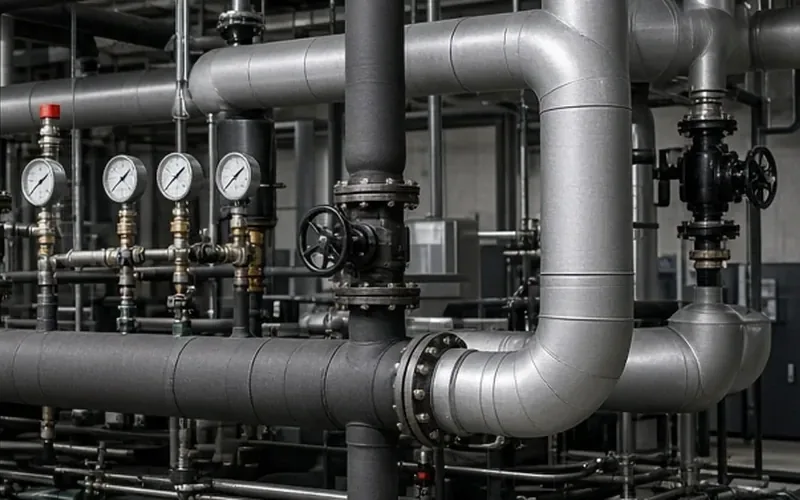
Sizing & Selection
Duty & Process
Heating, cooling, pasteurization, sterilization and high-pressure duties in tube-in-tube heat exchangers: what each process asks of the exchanger.
+ Learn More
Sizing & Selection
Fluid Testing
Why we test a product sample before sizing a tube-in-tube heat exchanger: viscosity at temperature, shear-thinning, thixotropy and custom tests.
+ Learn More
Sizing & Selection
Codes & Certifications
Which codes a tube-in-tube heat exchanger needs: ASME and National Board for pressure, 3-A and sanitary design for food, ISO 9001 and 45001 for suppliers.
+ Learn More