
1-805-484-2992
Quotes - Engineering - SalesCooling with Tube-in-Tube Heat Exchangers
Tube-in-tube heat exchangers provide efficient, uniform cooling through true counterflow, achieving the highest log mean temperature difference (LMTD) and rapid heat removal. The concentric design ensures low shear, gentle product flow, and reliable performance with viscous, particulate, or thermally sensitive fluids.
Typical Cooling Applications
- Food & Beverage: Post-pasteurization cooling of dairy, sauces, soups, juices, purees, fruit preparations, and hot-fill products.
- Personal Care & Cosmetics: Cooling viscous creams, lotions, gels, and emulsions after mixing or heating steps.
- Pharmaceutical & Biotech: Precise cooling of APIs, buffers, media, vaccines, and high-purity solutions under sanitary conditions.
- Chemical Processing: Cooling viscous polymers, resins, oils, emulsions, and temperature-sensitive chemical streams.
- Wastewater & Sludge: Cooling digested sludge, industrial effluents, and fibrous streams before dewatering or discharge.
- Other: Wort chilling in brewing, product-to-product regeneration, and cooling high-pressure or hot process fluids.
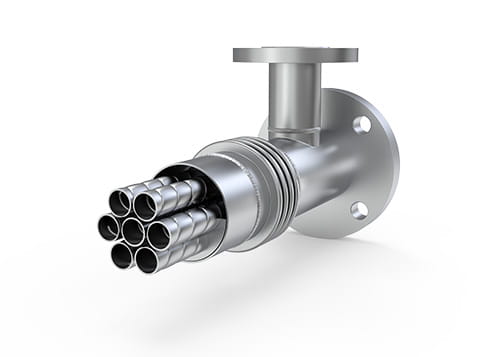
Sanitary Cooling
Tube-in-Tube Heat Exchangers
- 3-A, EHEDG & FDA Compliant
- Gentle on Particulates & Fibers
- Polished 316L, Full Drainability
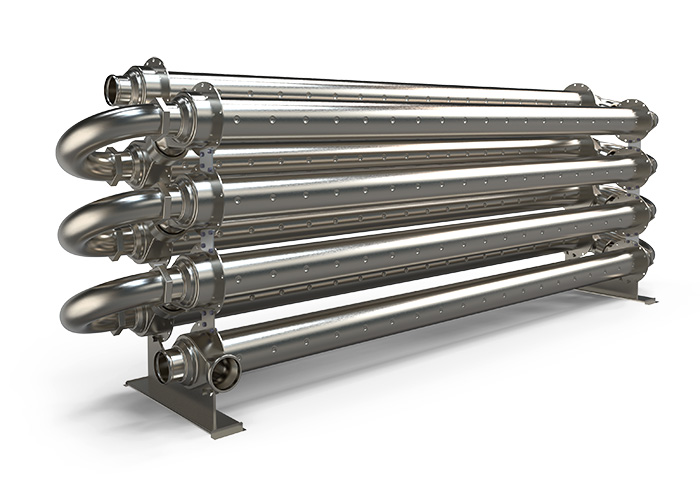
Industrial / High-Capacity Cooling
Tube-in-Tube Heat Exchangers
- High Flow & Heat Removal Rates
- Robust for Viscous & Abrasive Media
- Easy Mechanical Cleaning
Advantages for Cooling Processes
Tube-in-tube heat exchangers provide outstanding performance in cooling applications through true counterflow configuration, which delivers the highest possible log mean temperature difference (LMTD) and enables rapid, uniform heat removal even across large temperature differentials. This results in faster cooling rates and tighter outlet temperature control compared to parallel-flow or less efficient designs, minimizing thermal shock and preserving product quality in sensitive streams.
The concentric tube geometry creates gentle, low-shear flow paths on the product side, with controlled velocity that prevents texture damage, particle breakup, emulsion instability, or protein denaturation in viscous, particulate-laden, or shear-sensitive fluids such as dairy, sauces, purees, fruit preparations, biotech media, and emulsions. Unlike plate heat exchangers, tube-in-tube units have no narrow gaps or corrugations that could cause mechanical stress or clogging with fibers and particulates.
High heat transfer coefficients — further enhanced by optional dimpled, corrugated, or rifled inner tubes — allow quick temperature drops from high inlet temperatures (e.g., post-pasteurization at 85–95 °C down to 4–10 °C) in compact equipment. This capability supports critical duties such as post-pasteurization cooling, hot-fill product stabilization, wort chilling in brewing, and product-to-product regeneration where outgoing cold product pre-cools incoming hot product, recovering up to 90% of available heat and significantly reducing utility costs.
Sanitary versions are built with electropolished 316L stainless steel, full drainability, no internal dead zones, and hygienic connections that comply with 3-A, EHEDG, and FDA standards. These features ensure complete cleanability, prevent microbial harborage, and support validated clean-in-place (CIP) cycles with minimal water and chemical consumption. Full drainability also eliminates product hold-up and reduces contamination risk during product changeovers.
Industrial designs offer robust construction with thicker walls, corrosion-resistant alloys (duplex, super duplex, titanium, Hastelloy), and abrasion-resistant options for handling high-flow rates, viscous polymers, abrasive slurries, wastewater sludge, and chemically aggressive fluids. The simple geometry withstands pressure surges, thermal cycling, and mechanical cleaning when fouling occurs, ensuring long service life in harsh environments.
The compact, modular footprint requires minimal floor space and allows easy expansion by adding tube sections to match growing production needs. Installation is flexible, with options for horizontal, vertical, or stacked arrangements in space-constrained facilities. Maintenance is straightforward: inner tubes can be individually accessed or replaced, and the absence of complex gaskets or plate packs reduces downtime and spare parts inventory.
Fouling is inherently low due to optimized velocities, smooth surfaces, and the elimination of stagnant zones, resulting in longer production runs between cleaning events. Energy efficiency is maximized through regeneration capability and high thermal performance, lowering refrigeration or cooling water demand. Reliable, predictable operation reduces product losses, maintains consistent quality, and supports continuous processing with minimal operator intervention.
These combined advantages make tube-in-tube heat exchangers the preferred choice for precise, gentle, and cost-effective cooling in food and beverage (dairy, juices, sauces, hot-fill), pharmaceutical and biotech (APIs, media, vaccines), personal care (creams, lotions), chemical (emulsions, resins), and wastewater/sludge applications where product integrity, hygiene, efficiency, and reliability are essential.