
1-805-484-2992
Quotes - Engineering - SalesWhat 3-A asks of a tubular exchanger
Hygienic criteria for every product-contact surface
3-A Sanitary Standards are written for equipment that touches dairy and food products, and tubular heat exchangers have criteria of their own. They cover what the product touches, how smooth it is, whether cleaning solution can reach every surface, whether the unit drains, and which metals and rubbers are allowed. Dairy inspectors use them as their reference, and many food processors outside dairy write them into equipment specifications for the same reason.
A tube-in-tube suits the standard well. Product runs in a round, full-bore tube with no contact points, no gaskets inside the flow path and no narrow channels for residue to settle in. The effort goes into the details: the welds on the inner tube, the U-bend returns, the clamp ferrules at each end and how the bank is oriented so it empties when the pump stops.
The service side is treated differently. Steam, hot water or glycol in the annulus never touches product, so the jacket is not held to the product-contact finish. The standard does care that a leak cannot carry service fluid into product unnoticed, and that the exterior can be kept clean in a washdown area. On a triple-tube, where product flows in the middle annulus, both walls of that annulus count as product contact.
Request a Quote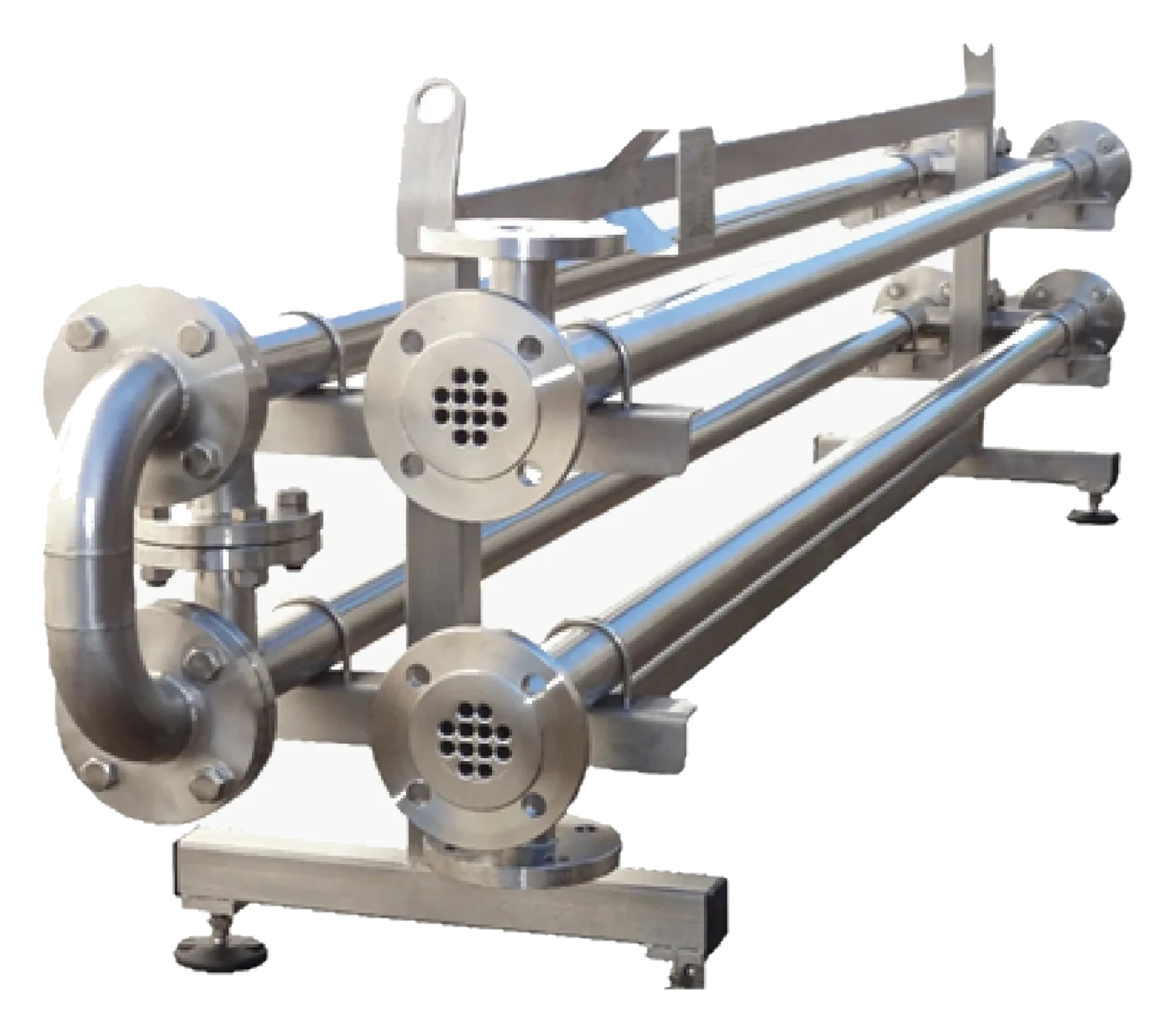
Any surface touched by product, or by liquid that drains back into product. 3-A governs its material, finish and cleanability; the service side of the jacket is not one.
3-A criteria on a tube-in-tube unit
These are the points a 3-A review examines on a tubular exchanger, with the way a tube-in-tube design answers each one.
| Criterion | Detail |
| Materials | 316L standard, 304L option; corrosion-resistant, nontoxic and nonabsorbent |
| Surface finish | Commonly 32 Ra or better on product contact, polished or electropolished |
| Welds | Continuous, ground flush and polished to match the tube |
| Returns | Sanitary U-bends with a smooth, full-bore radius |
| Connections | Tri-clamp sanitary ferrules with suitable gaskets |
| Elastomers | Compounds meeting 3-A criteria and FDA food-contact rules |
| Drainability | Self-draining as installed; no pockets that hold product |
| Cleanability | CIP reaches every product surface; ends open for inspection |
Finish where it counts
Roughness gives bacteria and soil somewhere to hold on. 3-A sets a maximum roughness for product contact, commonly 32 Ra or better, and electropolishing goes further by leveling the peaks a mechanical polish leaves behind. The finish has to carry through the weld zones; a polished tube with a rough bead every few feet defeats the purpose.
Welds on the inner tube
Most product-side welds in a tube-in-tube are butt welds joining tube to tube or tube to return bend. Made with full penetration under an inert gas purge, then finished flush on the inside, they leave no crevice. A weld with heavy oxidation, undercut or a proud bead is the most common reason a sanitary unit fails close inspection.
Drainage between runs
A unit that holds a puddle of product or rinse water at each low point invites growth between runs. Hairpin banks are mounted so every section falls toward a drain, and the returns are turned so nothing pools. Draining has to work in the installed position, which is why the mounting orientation belongs in the specification and not only on the drawing.
Gaskets and elastomers
On a welded tube-in-tube, the only elastomers on the product side are the clamp gaskets at the connections. They must be a compound accepted for food contact and suited to the product's fat content and to the CIP chemicals and temperatures. EPDM, FKM and silicone each have their place; a gasket chosen for one duty can swell or crack on another.
Getting a 3-A unit specified correctly
Built to 3-A versus carrying the symbol
Equipment built to the 3-A criteria and equipment carrying the 3-A symbol are not the same claim. The symbol may be applied only after an independent evaluator has checked the design and the build against the standard. Many processors are satisfied with documented 3-A design; a dairy inspector or a customer audit may want the symbol itself. Find out which your inspector and customers expect before you specify, since it changes what is documented and inspected.
Details that change the price
A few specification lines decide most of the cost: the finish grade, whether electropolishing is required, whether finish records are wanted for each section, and how many connections the unit carries. Tell us the product, the CIP chemistry and temperatures, the installed orientation and any customer audit requirements, and the unit can be priced and documented to what your inspector will actually check.
Call and talk it through with an engineer: 1-805-484-2992
3-A questions from processors
Not by regulation in most cases. 3-A is voluntary, and dairy inspectors are the ones who rely on it most. Many sauce, soup and beverage plants still specify it because it gives purchasing and QA a clear, recognized referance. If your customers audit your plant, check what their supplier questionnaires ask for before deciding.
Yes. 3-A permits 300-series stainless for product contact, and 304L is the lower-cost option on our sanitary units. The deciding factors are the product and the cleaning program, not the standard. Salty, acidic or chloride-bearing products and aggressive sanitizers are where 316L earns its higher price.
Yes, provided every product-contact surface can be reached by CIP and inspected. On a multi-tube, the inlet and outlet headers that split flow between tubes need the same attention as the tubes themselves. On a triple-tube, both walls of the product annulus must meet the finish, and the gap must clean as well as it heats.
Commonly about 5 ft/s across every product surface, enough to scour rather than just wet it. A single-tube bank is easy because the whole flow passes through one bore. A multi-tube unit needs enough CIP flow to keep every parallel tube above that velocity, which can mean a larger CIP pump than production needs.
Not usually. A mechanical polish to the required roughness meets the standard. Electropolishing earns its cost on sticky, high-sugar or high-protein products that bake onto the wall, and wherever an auditor or customer specifies it. It also leaves a chromium-rich surface layer that stands up better to aggressive cleaning.
Related
Sizing & Selection
Sanitary Design
Hygienic tube-in-tube heat exchangers for plants that need sanitary design but not 3-A: welds, tri-clamp joints, drainage, dead legs, finish, CIP and SIP.
+ Learn More
Sizing & Selection
ASME
ASME Section VIII tube-in-tube and double pipe heat exchangers: when a U stamp applies, MAWP, the hydrostatic test, data reports and which side is coded.
+ Learn More
Sizing & Selection
National Board
What National Board registration adds to an ASME stamped tube-in-tube heat exchanger: the NB number, a registered data report and jurisdiction acceptance.
+ Learn More
