
1-805-484-2992
Quotes - Engineering - SalesA long counterflow path wound into a small footprint
An Ultra-Coil takes the tube-in-tube principle - product in an inner tube, service fluid in the annulus around it - and winds the pair into a helix instead of running it as straight lengths joined by U-bends. The result is many feet of true counterflow packed into a cylinder that fits on a skid, beside a filler or inside a cabinet. Because the path is one continuous coil, there are no return bends to add, no bend gaskets, and very little product inside the unit at any moment.
It is the right choice when the duty asks for a close temperature approach at a modest flow: cooling water-for-injection at a point of use, trimming a product to within a few degrees of the utility, recovering heat between two small streams, or giving a pilot line the same geometry the production plant will run. Skid builders like it because the exchanger stops dictating the frame size. Coiling also sets up secondary flow across the tube, which lifts the film coefficient while the product is still laminar.
The trade-off is access and solids. A coil cannot be rodded or pulled, so the product side is cleaned by CIP alone, and the bore stays small enough that large pieces, long fibers and heavy slurries belong on a straight tube-in-tube instead. Drainage needs thought as well: a helix empties only when its axis is vertical and the pitch keeps every turn sloping toward the outlet. We confirm the orientation against your layout before the coil is quoted.
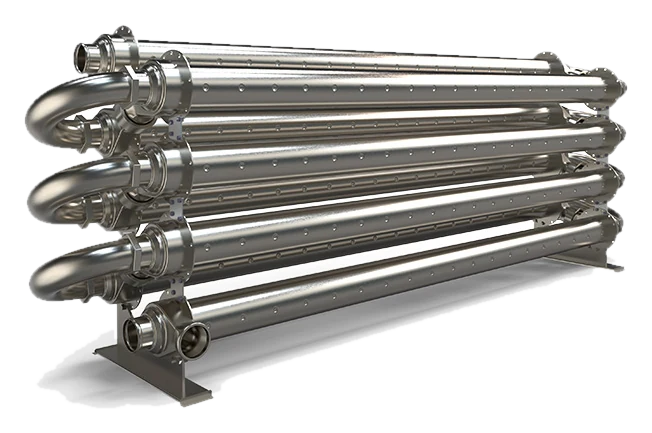
Coiling buys counterflow length without floor space; what it gives up is a straight bore you can rod and room for a large particle to pass.
Choose it for clean or fine-particle fluids where space and approach rule
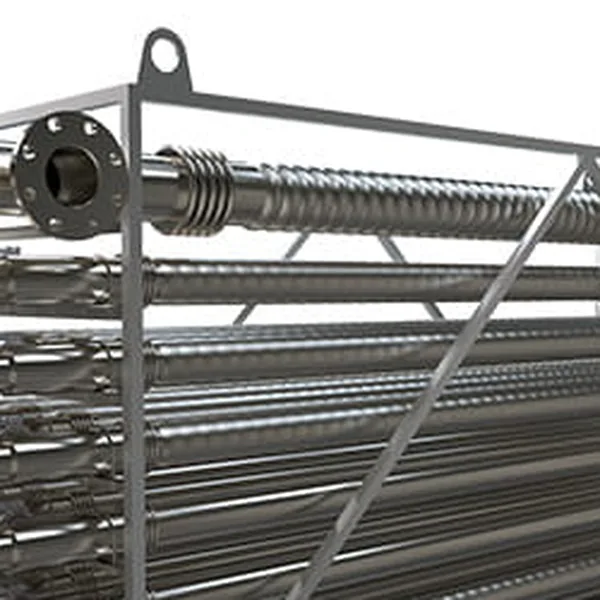
Close approach on a small skid
- Long true-counterflow length in one coil
- Approach of a few degrees at modest flow
- No U-bends or bend gaskets to maintain
- Footprint set by coil diameter, not length
- Inlet and outlet placed to suit the skid
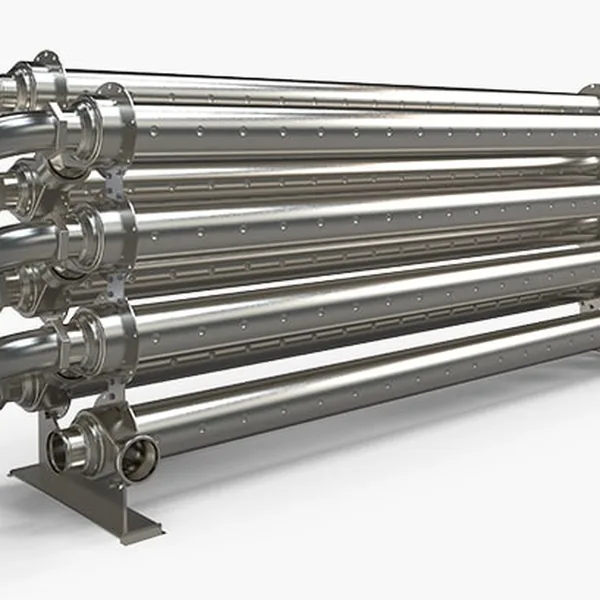
Low hold-up for small batches
- Little product left inside at changeover
- Quick to fill, flush and bring to temperature
- Suits pilot lines and point-of-use loops
- Sanitary 316L with polished product surfaces
- CIP and SIP through the process connections
Specify the Coil




Ultra-Coil options at a glance
What can be specified on a coiled unit. The final bore, coil diameter and length come out of the duty sizing, not a catalog table.
| Item | Detail |
| Geometry | Inner product tube and outer jacket wound together into one helical coil |
| Flow arrangement | True counterflow over the full coil length |
| Sanitary materials | 316L standard, 304L option; polished or electropolished product surfaces |
| Industrial materials | 316L or high-nickel alloys, chosen to suit the chemistry |
| Connections | Tri-clamp on sanitary units; flanged or threaded on industrial units |
| Cleaning | CIP and SIP on the product side; no mechanical access to the bore |
| Drainage | Vertical coil axis with a continuous slope to the outlet |
| Particles | Fine, soft particles only; pieces and long fibers go to a straight tube |
| Sizing variable | Coil length and number of turns, set from flow, temperatures and viscosity |
Designing around a coil
Why a coil transfers heat differently
Fluid moving around a bend is pushed outward, and in a helix that sets up a pair of counter-rotating secondary vortices across the tube section. They carry product from the center to the wall and back again. In a straight tube, a viscous product in laminar flow forms a slow layer at the wall that insulates the core; in a coil that layer is continually stirred, so the inside film coefficient rises without corrugation and without forcing the product into turbulence. The same secondary flow raises friction, so a coil shows more pressure drop per foot than a straight tube carrying the same product.
Hold-up volume and why skid builders care
Hold-up is the product sitting inside the exchanger at any moment. On a small batch, a pharmaceutical point-of-use loop or a pilot line, that volume is product lost or diluted at every changeover and water spent at every flush. A coil keeps it low because the bore is modest and there are no return-bend headers. For an OEM skid builder the other benefit is predictability: the coil has a fixed envelope, so the frame, piping and insulation can be drawn before the thermal sizing fixes the final length.
- Point-of-use cooling of water-for-injection ahead of a use valve
- Pilot and scale-up skids that mirror a production tube-in-tube
- Heat recovery between two small, clean process streams
- Trim heating or cooling of flavors, additives and minor ingredients
Where the coil is the wrong answer
A coil is not a slurry exchanger. Pieces that would pass a straight tube can lodge against the outer wall of a tight turn, and once something sticks there is no way to rod it out. Products that foul heavily, burn on or set when cooled need a straight run that can be opened. Very large flows also lose the footprint advantage, because coil diameter and pitch grow untill a stacked tube-in-tube bank is the simpler build. If the product carries visible solids or fibers, size it on a straight design and keep the coil for the clean side of the process.
Getting orientation and cleaning right
Drainage is decided on the drawing. Mounted with its axis vertical and enough pitch, a helix sheds liquid turn by turn toward the low connection; laid on its side, every turn becomes a trap. CIP needs the same discipline, and the cleaning pump has to be sized for the coil's pressure drop, which is higher than a straight run of equal length. Send us the flow, inlet and outlet temperatures, viscosity at both ends of the range and the space available, and we will size the coil and show its orientation.
Call and talk it through with an engineer: 1-805-484-2992
Before you order a coil
Closer than most tubular layouts in the same space, because the whole length runs in true counterflow and length is inexpensive in a coil. The practical limit is how much pressure drop you accept for that length. Approaches of a few degrees are realistic on clean, thin fluids; a viscous product needs more length for the same approach, and its viscosity at the cold end usually sets the limit.
Yes. Sanitary coils are built for SIP on the product side, with 316L product surfaces and tri-clamp ends. The points to check are condensate removal from the low end of the coil and the time the last turn takes to reach sterilizing temperature, so the vertical orientation and a drain at the bottom connection matter even more for SIP than for CIP.
Fine, soft particles such as pulp cells or ground spice pass well; firm pieces and long fibers do not belong in a coil. The limit is not only the bore but the turn, where pieces can bridge against the outer wall. If you can see the pieces in the product, choose a straight tube-in-tube where the bore is sized to the particle and can be opened for inspection.
On viscosity at temperature, never on a single room-temperature figure. Secondary flow helps the film coefficient, but pressure drop climbs quickly as the product thickens toward the cold end. We size from a viscosity curve across the operating range and, for shear-thinning products, from rheology data, so the pump and the coil length are chosen together rather than one after the other.
Related
Heat Exchangers
Tubular vs Plate & Shell
Difference between plate and tubular heat exchangers, and shell-and-tube: viscosity, particles, fouling, pressure, cleaning, footprint and cost compared.
+ Learn More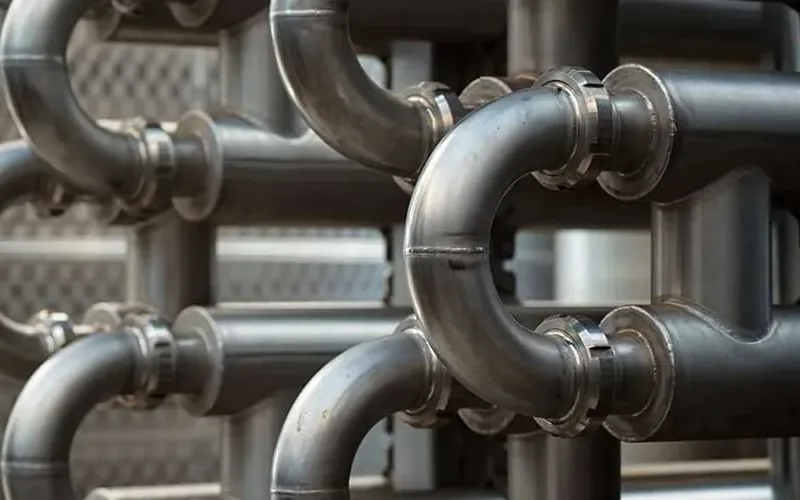
Heat Exchangers
Tube-in-Tube
Tube in tube heat exchanger with one full-bore product tube in a jacket, so pieces and fibers pass intact. Sanitary or industrial builds, sized to duty.
+ Learn More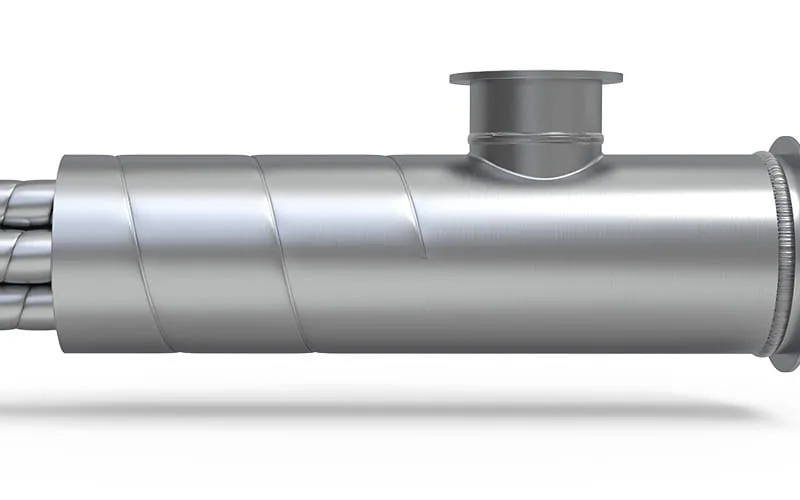
Heat Exchangers
Multi-Tube
Multi tube heat exchanger with several product tubes in one jacket: more surface per foot for juices with pulp, creams and smooth sauces, sized to duty.
+ Learn More
