
1-805-484-2992
Quotes - Engineering - SalesAn oxide film that seawater cannot break
Commercially pure titanium for the wetted product tube
Titanium's corrosion resistance comes from a thin, tightly bonded oxide film that forms instantly in air or water and repairs itself whenever oxygen or an oxidizer is present. Chlorides that pit stainless steel do not break it at ordinary temperatures, so seawater, brackish water and most chloride brines leave titanium essentially untouched. For heat exchanger tube the usual choice is commercially pure Grade 2, with alloyed grades held in reserve for hotter, more aggressive brines.
On a tube-in-tube it is chosen for the stream that defeats every stainless: seawater-cooled process coolers, hot salt and geothermal brines, wet chlorine and hypochlorite, chlorine dioxide bleach chemistry, and oxidizing acids such as nitric. Because the film thrives on oxidizers, titanium is often at its best in exactly the chemistry that attacks other metals hardest. It also stands up well to erosion by fast-moving seawater.
The limits are firm. Reducing acids such as hydrochloric and sulfuric, above dilute strength or at temperature, dissolve the film faster than it can heal. Fluoride ions attack titanium even at low concentration. Dry chlorine, lacking the moisture the film needs, can react violently with the metal. Under some conditions titanium also absorbs hydrogen and turns brittle. None of these are rare corner cases, so every titanium duty starts with the full chemistry.
Request a Quote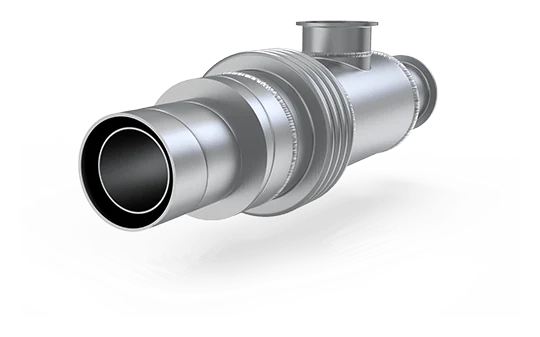
The workhorse titanium for tubeCommercially pure Grade 2 covers most seawater and chloride brine duties; palladium- or nickel-molybdenum-bearing grades take over in hotter brines with crevices.
Titanium in the wetted tube
How commercially pure titanium behaves on a tube-in-tube, with the conditions to watch before it is chosen for a corrosive stream.
| Property | Detail |
| Usual grade | Commercially pure Grade 2 tube |
| Density | A little over half that of steel, so units are lighter |
| Seawater | Essentially no pitting, crevice or erosion attack at ordinary temperatures |
| Oxidizing media | Excellent in wet chlorine, hypochlorite, chlorine dioxide and nitric acid |
| Reducing acids | Poor in hydrochloric and stronger sulfuric acid, especially when hot |
| Fluorides | Attacked even at low fluoride concentration |
| Hot brine crevices | Alloyed grades considered where crevice attack is a risk |
| Wall thickness | Thin wall usual; no corrosion allowance needed in suitable service |
Why only the wetted tube is titanium
In most titanium tube-in-tubes the corrosive fluid runs in the titanium inner tube, while the annulus carries clean cooling water, steam or glycol inside a stainless or carbon steel jacket. That puts the expensive metal only where the attack is. If seawater were the service fluid instead, it would wet both the jacket and the outside of the inner tube, so routing it through the inner tube usually costs less.
- Titanium tube carries the seawater, brine or chlorine chemistry
- Jacket in 316L or carbon steel for the utility
- Titanium cannot be fusion welded directly to steel
- Galvanic coupling reviewed for the service water
Cost and the thin wall
Titanium tube costs much more per pound than stainless, but the comparison per foot is closer than it looks. Its low density means more feet of tube per pound, and because it needs no corrosion allowance in suitable service, walls are usually thin. Thin walls also shrink titanium's one thermal drawback, a conductivity well below carbon steel, though still above austenitic stainless.
- More tube per pound than steel or stainless
- No corrosion allowance in suitable service
- Conductivity above stainless, below carbon steel
Where titanium works and where it fails
Reading the acid correctly
Oxidizing or reducing is the whole question. Titanium relies on its oxide, and oxidizing species such as dissolved oxygen, ferric or cupric ions, nitric acid and chlorine keep that oxide healthy. Pure hydrochloric or sulfuric acid starves it; above dilute strength, and especially when hot, attack can be rapid. Small amounts of an oxidizing contaminant can inhibit attack in a reducing acid, which is why a process stream is judged on its actual composition rather than on its name.
Hydrogen, fluoride and hot crevices
Three less obvious hazards trip up titanium. Hydrogen can be absorbed when the metal is coupled to a more active metal that is corroding, or held under cathodic protection, especially above about 170 F, and it forms brittle hydrides. Fluoride, including traces from some cleaning chemicals and process streams, attacks the oxide directly. And in hot chloride brines, crevices under gaskets and deposits can start attack in Grade 2 that the alloyed grades resist.
- No fluoride-containing cleaners on titanium surfaces
- No coupling to actively corroding steel in the same water
- An alloyed grade for hot brine where crevices exist
- Iron smears kept off the surface during installation
Specifying a titanium unit
Send the full composition of the corrosive stream, including oxidizers and any fluoride, the temperature range, the pressure and which side of the exchanger it will run on. We will confirm the grade, route the corrosive fluid through the titanium tube and choose the jacket for the utility, so the alloy is used only where it earns its cost.
Call and talk it through with an engineer: 1-805-484-2992
Titanium questions worth asking
It is inert and appears in some food and pharmaceutical equipment, but most sanitary tube-in-tubes stay with 316L or AL-6XN, which are easier to polish, weld and document under sanitary programs. Titanium earns a place on the food side mainly where a highly corrosive brine or a chlorinated stream would defeat the stainless grades. Tell us the product and the sanitary requirement and we will weigh both.
Commercially pure titanium resists seawater accross the range normally met in process cooling, including fast flow that would erode copper alloys. The limit appears in hot, concentrated brines with tight crevices, where an alloyed grade is the safer specification. Biofouling still grows on titanium in raw seawater, so velocity and cleaning access remain part of the design.
Because the jacket usually carries clean water, steam or glycol that a stainless or carbon steel jacket handles at a fraction of the cost. Putting titanium only on the wetted inner tube keeps the price close to what the corrosion problem justifies. A full titanium build is warranted when both fluids are corrosive, for example seawater cooling a chlorinated brine.
Most caustic and nitric acid cleaning programs are safe. Avoid any cleaner containing fluoride or hydrofluoric acid, and be careful with hot hydrochloric or sulfuric acid descalers, which can strip the oxide. If the stream scales, tell us what scale forms and how you plan to remove it, so the cleaning method is agreed before the material is fixed.
Related
Heat Exchangers
316L Stainless
316L stainless tube-in-tube heat exchangers: the sanitary standard, with molybdenum for chloride pitting resistance, low carbon for welds, polished finish.
+ Learn More
Heat Exchangers
304L Stainless
304L stainless tube-in-tube heat exchangers: the lower-cost sanitary grade for low-chloride foods and hot water service, and where 316L is the safer buy.
+ Learn More
Heat Exchangers
2205 Duplex
2205 duplex tube-in-tube heat exchangers: about twice the yield strength of 316L and strong chloride cracking resistance for brines and produced water.
+ Learn More