
1-805-484-2992
Quotes - Engineering - SalesThe fluid decides the geometry
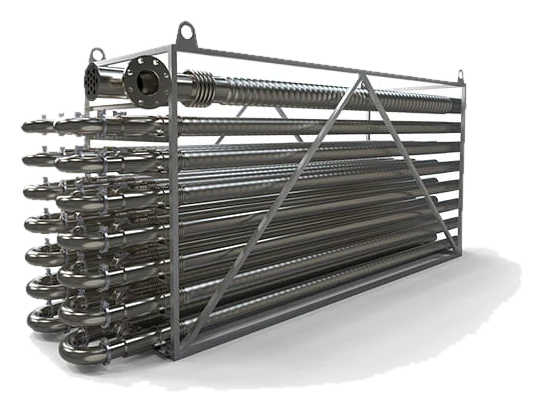
A tube-in-tube unit is a family of designs rather than one design. Every member puts the product and the service fluid in concentric channels, flowing in opposite directions. They differ in how many product channels there are, how wide those channels are and which face of the channel transfers heat. Choosing among them comes down to three properties of your product: the largest solid it carries, how thick it is at the cold end of the duty, and how much pressure drop the line can afford.
Pieces come first. A diced vegetable or a fruit chunk needs a full, open bore, which narrows the choice to a single product tube. Fine pulp, seeds and short fibers pass smaller tubes, and that opens up multi-tube bundles with more surface per foot. Paste-like product that crawls along the wall in laminar flow does best in an annulus heated from both sides, which is the job of the triple-tube.
Pressure, footprint and cleaning narrow it further. Pipe-size double pipe with flanged ends handles the high-pressure industrial duties. A coiled unit fits a close-approach duty onto a skid where straight hairpins will not. And when the product is shear-sensitive or must see a wide, gentle channel, the annulus of a plain concentric unit can carry it in place of the inner tube.
Product in the tube
- Full round bore passes the largest pieces
- Straight bore easy to inspect and clean in place
- Service fluid flows in the annulus around it
Product in the annulus
- Wide, gentle channel for shear-sensitive product
- Heated from both faces in a triple-tube
- Gap must clear the largest particle
Match your product to a design
Each row names the kind of fluid that points to a design and the reason it fits. Follow the link for the geometry, the options and the limits of that design.
| YOUR PRODUCT | DESIGN | WHY IT FITS |
| Chunks, dices, whole pieces | Tube-in-Tube | One open bore with no internal edges, so pieces travel through intact and nothing bridges |
| Pulpy juice, smooth sauce | Multi-Tube | Several smaller tubes in one jacket add surface per foot for fine particles and short fibers |
| Paste, puree, heavy filling | Triple-Tube | Product in the middle annulus is heated or cooled from both faces, shortening a laminar duty |
| High-pressure process stream | Double Pipe | Pipe-size flanged or threaded hairpins that hold high pressure and open for mechanical cleaning |
| Shear-sensitive or high-flow product | Concentric Tube | The annulus can carry the product when a wide, gentle channel matters more than bore |
| Compact, close-approach duty | Ultra-Coil | Coiled counterflow with low hold-up volume for skids and tight mechanical rooms |
| Clean fluid, cost question | Tubular vs Plate & Shell | A frank look at when a plate pack or shell-and-tube is the cheaper and better buy |
Three tests that settle the design choice
Measure the largest piece, not the average
Particle specifications are often written as a typical size, but the exchanger has to pass the biggest piece that ever arrives, plus the occasional cluster of pieces stuck together. A bundle sized on the average dice works on the first day and plugs on the day the slicer blade wears. Give us the maximum dimension, the shape and whether the pieces are firm or fragile. A firm cube and a soft peach slice of the same size behave differently in a narrowing passage, and the geometry follows the worst case.
Viscosity at the cold end sets the length
A product that pours easily at fill temperature can be many times thicker once it has been cooled, and most of the exchanger's length is spent in that thick zone. Flow there is laminar, usually far below a Reynolds number of 2,100, and the product-side film coefficient drops with it. Corrugated tubes and the two-sided triple-tube are the usual answers. Both buy back heat transfer, but corrugation trims the largest piece that can pass, so it is kept for products without fragile pieces.
- Corrugation helps most in laminar and transition flow
- A triple-tube adds a second heated face to the product
- Parallel paths cut velocity and pressure drop, at some cost in film coefficient
- A hotter service fluid thins the product but raises the wall temperature
Pressure, space and cleaning come last
Once the product side is settled, the remaining choices are mechanical. Duties at high pressure, including industrial streams at 1500 psi and beyond, move to pipe-size double pipe with flanged or threaded ends. A skid builder short on space looks at the coiled unit. Plants that clean in place need a fully drainable sanitary layout, while dirty industrial streams may favor ends that open for rodding. None of these choices should override what the product itself demands.
Choosing between the designs
Yes, if it is sized for the chunky product. A single-tube unit with a bore that passes the largest pieces will also run a smooth sauce, with somewhat less surface per foot than a multi-tube built only for the sauce. Sizing for the easy product and adding a chunky one later is the mistake that leads to plugged inlets and lost production.
For a viscous product in laminar flow it often is, because corrugation disturbs the slow boundary layer and raises the film coefficient, which shortens the unit. It adds little for a thin fluid already in turbulent flow. It also reduces the largest piece that will pass, so we leave it out wherever pieces must arrive whole.
An annulus gives a wide, gentle channel and, in a triple-tube, two heated faces. But it's smallest dimension is the gap, not the diameter, so a piece that slips easily through a round bore can wedge across a narrow gap. Product goes in the annulus only when its largest particle is comfortably smaller than that gap.
That depends on the temperature change, the viscosity across it and the allowable pressure drop, so there is no rule of thumb we would stand behind without the numbers. Send the flow, the inlet and outlet temperatures and the viscosity at temperature, and we will return the section count, the arrangement and the predicted pressure drop with the quote.
Related
Heat Exchangers
Tube-in-Tube
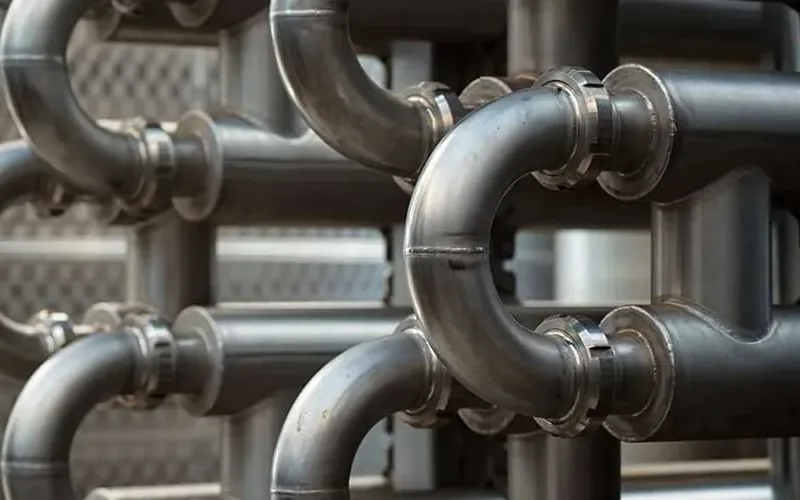
Tube in tube heat exchanger with one full-bore product tube in a jacket, so pieces and fibers pass intact. Sanitary or industrial builds, sized to duty.
+ Learn More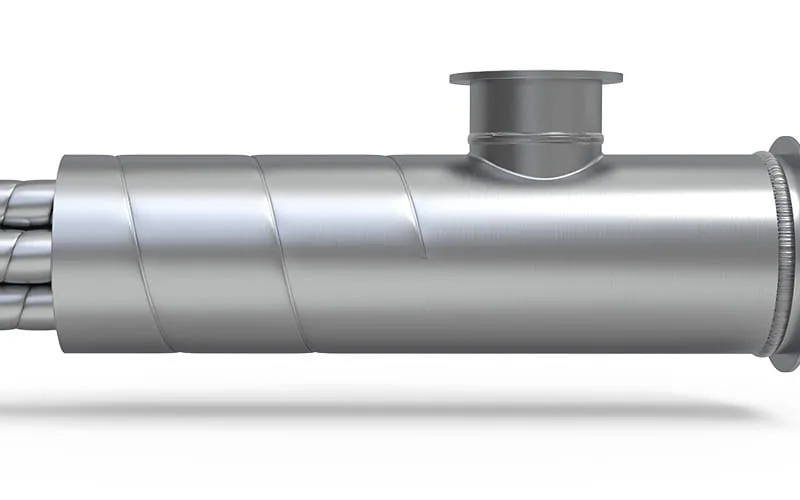
Heat Exchangers
Multi-Tube
Multi tube heat exchanger with several product tubes in one jacket: more surface per foot for juices with pulp, creams and smooth sauces, sized to duty.
+ Learn More
Heat Exchangers
Triple-Tube
Triple tube heat exchanger with product in the middle annulus, heated or cooled from both sides. For purees, pastes and fillings too thick for one tube.
+ Learn More