
1-805-484-2992
Quotes - Engineering - SalesHeat from both sides for heavy product
A triple-tube unit nests three tubes on one axis. Service fluid flows through the innermost tube and through the outer jacket, and the product travels the annular space between them. The product layer is therefore heated or cooled through its inside and outside faces at once, and no part of it is more than half the gap away from a heat transfer surface. For a product moving in slow laminar flow, that short conduction path is the whole point of the design.
It is the design for very viscous product: fruit and vegetable purees, tomato paste, pie and bakery fillings, puddings, cheese sauce, thick creams and heavy industrial pastes. In a plain tube these products creep along the wall while the core lags behind, so the outlet temperature is never uniform and the unit grows very long. Two active faces and a thin layer shorten the length needed for the same duty and even out the temperature across the stream.
The limit is the gap. The annulus must be wider than the largest particle, with margin for clusters, and a paste carrying large pieces belongs in a single bore instead. Two product-contact surfaces also mean two surfaces to clean and inspect, and the inner service tube must be supplied and drained in every section, which adds connections and cost.
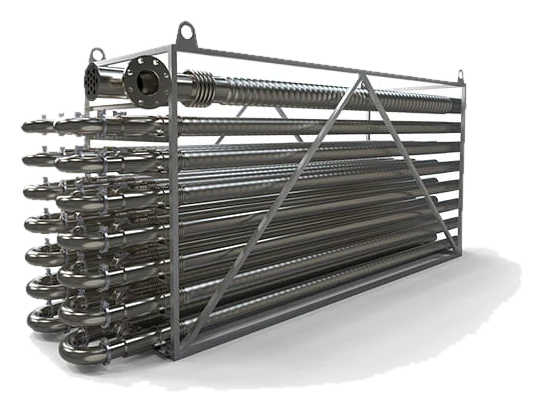
In laminar flow the center of a thick product barely feels the wall - a triple-tube halves that distance by giving the product a second wall.
Annular product path, service fluid on both faces
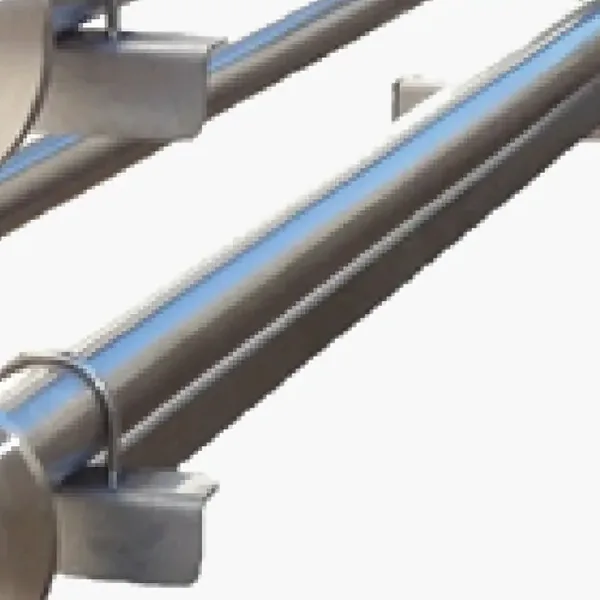
Shorter length for thick product
- Product treated through inner and outer walls
- Thin product layer, even outlet temperature
- Less length than a single tube for the duty
- Smaller product hold-up for the same duty
- Counterflow on both service paths
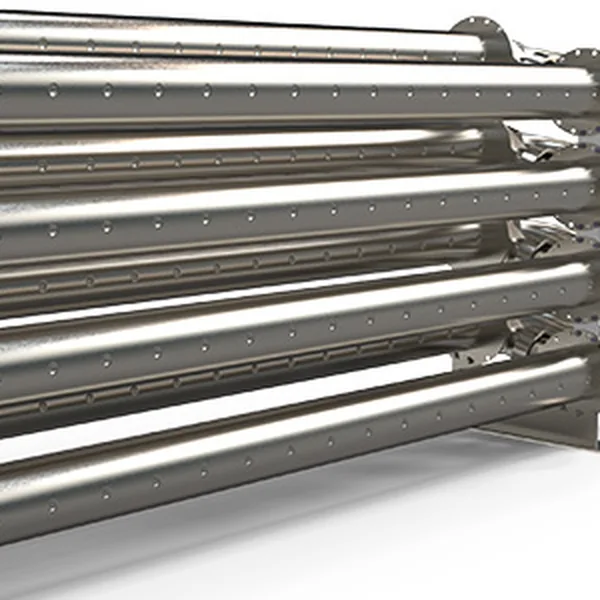
Made for purees and fillings
- Purees, pastes, puddings and fillings
- Annular gap sized to the largest particle
- Polished 316L on both product faces
- CIP velocity checked for the annulus
- Sanitary tri-clamp product connections
Design Points




How a triple-tube is laid out
Three concentric tubes give two service paths and one product path. The table shows what runs where and which dimensions are fixed during sizing.
| Element | Detail |
| Inner tube | Service fluid; heats or cools the product's inside face |
| Middle annulus | Product path, gap sized to the largest particle |
| Outer jacket | Service fluid; heats or cools the product's outside face |
| Flow pattern | Product in counterflow to the service fluid on both faces |
| Best-fit products | Purees, tomato paste, fillings, puddings, cheese sauce, thick creams |
| Product surfaces | Two, polished or electropolished 316L in sanitary builds |
| Cleaning | CIP and SIP through the annulus, fully drainable |
| Enhancement | Corrugated tubes optional where no fragile pieces are present |
Designing around a thick product
Annulus gap versus particle size
The narrowest dimension in a triple-tube is the radial gap between the inner service tube and the outer product wall, not the diameter of any tube. A particle that would slip through a round bore of the same flow area can wedge across that gap. We size the gap from your largest piece, add margin for clusters and fibers, and check the heat transfer the wider gap gives up. When the pieces force a gap so wide that the second face adds little, a single-tube unit is the honest answer.
Pressure drop is the real limit
Thick product resists flow, and an annulus has more wetted perimeter than a tube of equal area, so pressure drop per foot is higher. Most viscous duties are limited by what the product pump and the downstream equiptment will tolerate, not by heat transfer. The viscosity that matters is the one at each temperature along the path; a puree that flows easily hot can be many times thicker once cooled. Measured viscosity data, from a sample test where needed, keeps the pressure drop prediction honest.
- Viscosity at the cold end drives pressure drop
- Shear-thinning products thin at the wall, which helps
- Parallel paths lower velocity and pressure drop
- Restarting with cold product in the unit is the worst case
Cleaning both product faces
Both product-contact surfaces need to see cleaning velocity, and if the inner tube drifts off center the solution runs faster where the gap is wide and slower where it is narrow. Supports that keep the inner tube centered, a drainable layout and CIP flow sized for the annular flow area are what make a triple-tube clean reliably. After a heavy product such as a fruit filling, a pre-rinse that pushes the residue out before caustic is applied saves chemical and time.
Heating and cooling in one unit
Because the inner tube and the jacket are seperate service circuits, a long triple-tube line can be split into zones: hot water or steam on the first sections to bring a filling up to temperature, then cooling water and glycol on the later ones. Each zone is sized on the product's viscosity at its own temperature range. The heating zone usually runs short, because hot product is thin; the cooling zone runs long, because the product thickens as it cools.
- Heating zone on steam or hot water, kept short
- Cooling zone on cooling water, then glycol for the final approach
- Each zone sized on viscosity across its own range
Triple-tube questions from processors
When the product is thick enough that even a corrugated wall cannot bring the center of the stream to temperature in a reasonable length. Corrugation thins the boundary layer at one face; the triple-tube adds a second face and halves the conduction distance. For moderately viscous products corrugation may be enough, so we compare both during sizing.
There is no single cutoff, because the answer depends on flow, temperature change and the pressure drop the line can take. As a guide, products in the thousands to tens of thousands of cP, such as ketchup-like pastes and dense purees, are where the second face usually pays for itself. We decide from measured viscosity at temperature, not from a product name.
Small, firm pieces can, provided the annular gap is comfortably wider than the largest piece and any clusters. Large or soft pieces risk wedging in the gap and being smeared against the walls. A fruit preparation with whole berries or large dices is better served by a full-bore single tube, even though it will be longer.
Yes. The inner tube and the outer jacket are separate service paths, and each section needs supply and return connections for both. They are normally fed from the same utility header, piped in parallel. The extra connections add cost and space compared with a single-tube unit, which is part of the trade for the shorter length.
Related
Heat Exchangers
Double Pipe
Double pipe heat exchanger in pipe sizes with flanged or threaded ends for high-pressure, small-to-medium duties, in carbon steel through titanium.
+ Learn More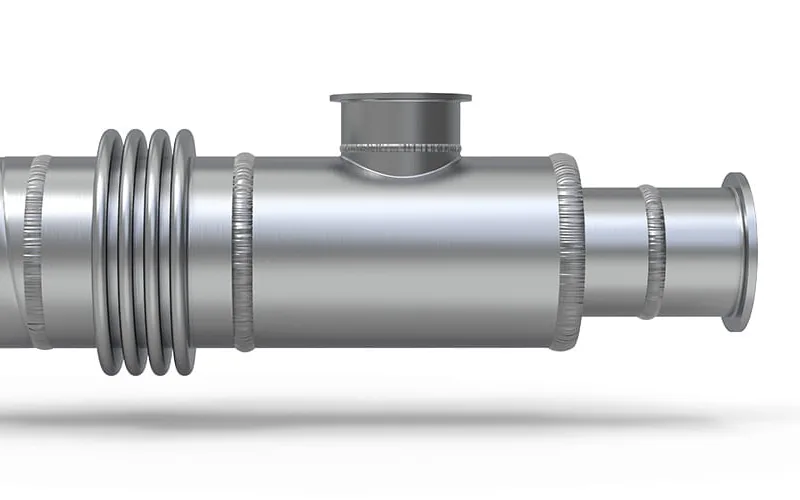
Heat Exchangers
Concentric Tube
Concentric tube heat exchanger with coaxial channels: how the product side, annular gap and flow are chosen, including product in the annulus.
+ Learn More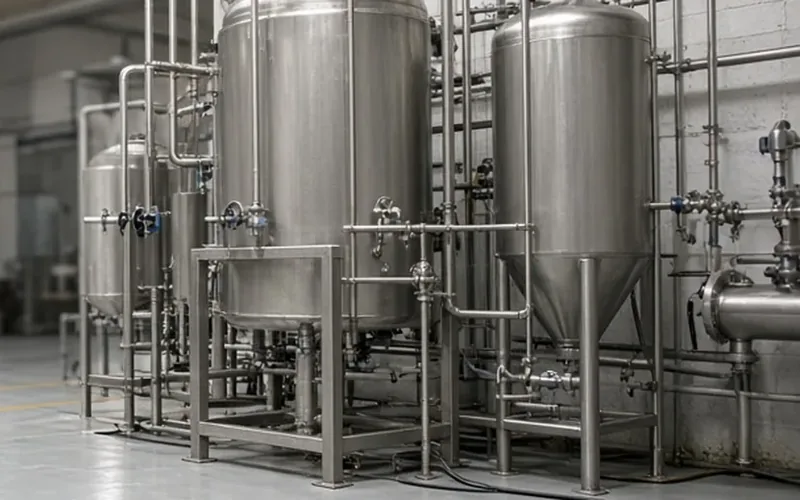
Heat Exchangers
Ultra-Coil
Ultra-Coil coiled tube-in-tube heat exchangers: close temperature approach and low hold-up volume in a compact footprint for skids and point-of-use duty.
+ Learn More
