
1-805-484-2992
Quotes - Engineering - SalesBeverages a plate pasteurizer cannot keep up with
Pulp, juice sacs, fiber and thick concentrate
Most beverages are thin and clean and belong on a plate, and we will say so when that describes your product. A filtered apple juice, a clear tea or a soft drink base has no pulp to trap and a viscosity close to water, so the compact plate pack is the cheaper buy. The tube-in-tube is for the beverages that are nothing like that.
Orange juice with added pulp, juice carrying whole sacs and cells, smoothies thick with fruit fiber, oat and other plant-based drinks with suspended solids, coconut water with pieces of flesh, and concentrates heavy enough to pour like syrup. On a plate these trap pulp at the contact points, lose sacs to shear and run short between cleans. In a full-bore tube they pass through intact and the run goes the distance.
Beverage plants are also fast-changeover plants. A sanitary unit in 316L with clamp ends drains completely between flavors and cleans in place, and one bank can run both a pulpy and a clear product as long as it was sized for the harder of the two.
Request a Quote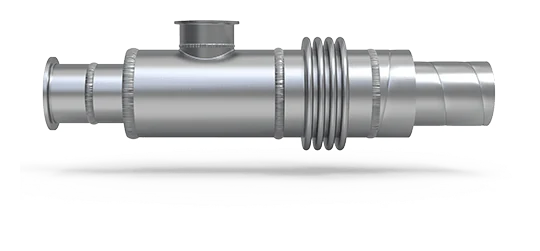
Juice sacs survive a full bore, not a plate gap
Citrus sacs are fragile cells full of juice. Shear and narrow gaps burst them, and a burst sac is just cloudy juice. Wide, even flow keeps them whole for the customer to see in the bottle.
Beverage duties on tube-in-tube
Juices
- Orange juice with added pulp
- Juice with whole sacs or cells
- Cloudy apple and pear juice
- Coconut water with flesh
Blended drinks
- Fruit and vegetable smoothies
- Oat, almond and soy drinks
- Protein shakes ahead of filling
- Fruit nectars with high pulp
Concentrates
- Juice concentrate cooling after evaporation
- Fruit syrup bases for later dilution
- Pulpy nectar bases for blending
Beverage type and the right geometry
The amount and kind of suspended material, not the flow rate, chooses the design for a beverage line.
| PRODUCT / DUTY | DESIGN | WHY IT FITS |
| Juice with whole sacs | Tube-in-Tube | Moderate velocity in one full bore keeps sacs and cells intact through heating and cooling |
| Orange juice with fine pulp | Multi-Tube | Short pulp passes the smaller bores easily, and the bundle adds surface for high flow rates |
| Thick smoothie base | Triple-Tube | A thick, fine-fibered base is heated and cooled from both sides of a thin layer |
| Hot-fill skid for light pulp | Ultra-Coil | Close-approach heating and cooling in a small frame for lightly pulped drinks |
Hot fill, plant-based drinks and when a plate is better
Hot fill. High-acid beverages bottled hot are commonly heated to 185 F to 195 F, held briefly and filled, and the hot product then pasteurizes the inside of the container before it is cooled. The exchanger heats the beverage and, on lines with a return loop, cools any product the filler did not take. With a pulpy juice the heater must do this without baking pulp onto the wall, which is why hot water rather than steam is the usual jacket fluid.
Plant-based drinks. Oat, almond and soy drinks carry fine fiber and protein, and oat bases also carry starch that enzymes have already broken down. Heating them is a fouling duty, because protein and residual starch build up on a hot wall. A full bore with controlled wall temperature runs longer between cleans. Many of these drinks are low-acid and sold shelf stable, so the same tube bank often sits inside an aseptic line, covered on our aseptic and UHT page.
When a plate is the better buy. For a clear, filtered, water-thin beverage at modest pressure, a plate gives more surface for less money and floor space, and a tube-in-tube adds nothing the product needs. The deciding point is pulp and fiber. If the line runs only clear products today but will add a pulpy one, size for the pulpy product now rather than rebuilding later.
Call and talk it through with an engineer: 1-805-484-2992
Details beverage lines ask about
Dissolved gas and carbonation
Gas comes out of solution as a beverage warms, and bubbles on the wall cut heat transfer and make flow erratic. Lines handling carbonated or air-laden product keep enough back pressure on the product side to hold gas in solution through the heater. Juice lines often deaerate upstream as well, since dissolved oxygen also damages flavor and vitamin C.
Concentrates and viscosity
Juice concentrate flows like a light syrup when warm and thickens quickly as it is cooled toward storage temperature. Pressure drop in a concentrate cooler is set at the cold end, and the design is checked at the highest Brix the plant will run. A viscosity curve measured on the concentrate itself is the only reliable basis for the length.
Flavor changeovers
A beverage line may run five flavors in a day. A drainable bank pushed out with water and rinsed clears one flavor quickly, and with no gasket grooves inside the product path, no color or aroma carries into the next. Allergens such as soy or tree nuts call for a full CIP and a verified final rinse before the changeover is signed off.
Energy recovery
Most beverage pasteurizers recover heat by letting hot finished product warm the cold incoming product. With the annulus gap sized for the pulp, a pulpy beverage can run on both sides of a regenerative tube-in-tube without trapping it, which a plate regenerator struggles to do. The saving in steam and chilled water is often what pays for the extra length of the tube bank.
Juice and smoothie line questions
Yes. Size the bore and velocity for the pulpiest product and the length for the hardest duty, and a clear juice then runs through comfortably. The penalty is a somewhat larger unit than a clear-only line would need. Going the other way, adding pulp to a line built for clear juice, is where plants run into trouble.
Small seeds such as strawberry or kiwi pass a full bore without trouble. Larger seeds and whole fruit pieces need the bore checked against their size. The real risk point is usually not the tube but a valve, reducer or flow meter upstream, so check the whole product path with the same particle in mind.
Hot-fill high-acid juices are commonly heated to 185 F to 195 F and held briefly. The exact figure comes from the plant's process authority and depends on the product and container. Tell us the target, the hold and wether unfilled product returns through a cooler, and we will size heating, hold and cooling to match.
For clear juice, usually yes, because a plate packs more surface into less steel. For pulpy juice the comparison changes, since the plate's lower price buys short runs, frequent cleans and product lost at each one. Compare cost over a year of operation, including cleaning time and downtime, rather than purchase price alone.
It can, with care. Oat drink fouls with protein and starch and is often low-acid, while orange juice is high-acid and pulpy, so the cleaning regime and heat treatment differ. Size the bank for the pulp and the fouling together, and plan a full CIP plus an allergen check at every switch between them.
Related
Sanitary
Aseptic & UHT Products
Aseptic heat exchangers in tube-in-tube form for UHT and low-acid foods with particulates: heating to sterilizing temperature, aseptic cooling and SIP.
+ Learn More
Sanitary
Dairy
Tube-in-tube heat exchangers for dairy: stirred yogurt after the break, puddings, cheese sauce, fruit preparations and high-solids milk concentrates.
+ Learn More
Sanitary
Soups & Prepared Foods
Prepared food heat exchangers for soups, chili, stews and ready meals with pieces: cook, hold and cool beans, vegetables and meat without breaking them.
+ Learn More