
1-805-484-2992
Quotes - Engineering - SalesSuper-austenitic stainless for severe chlorides
High molybdenum, high nickel, nitrogen for strength
AL-6XN is a super-austenitic stainless steel: roughly 24 percent nickel, 20 to 22 percent chromium, 6 to 7 percent molybdenum and an addition of nitrogen. The molybdenum and nitrogen push its pitting resistance number into the mid-to-high forties, close to double that of 316L. The high nickel keeps the structure fully austenitic and gives far better resistance to chloride stress-corrosion cracking than any 300-series grade.
It sits on the ladder where 2205 duplex runs out of margin: hot seawater, concentrated chloride brines, acidic chloride streams and aggressive food brines such as pickle, olive and soy brines. Because it is austenitic, it forms much like 316L, polishes to a sanitary finish and takes the same tri-clamp construction, so it is the usual upgrade when a food or pharmaceutical duty is too salty for 316L but must stay sanitary.
The price is high, and it buys a specific benefit. Where the fluid is a neutral or acidic chloride solution, AL-6XN closes the gap between duplex and titanium while keeping the fabrication and inspection habits of an austenitic stainless. Where the chemistry is strongly oxidizing, such as concentrated hypochlorite or wet chlorine, titanium usually does better for the money, and a hot reducing acid may call for a nickel alloy.
Request a Quote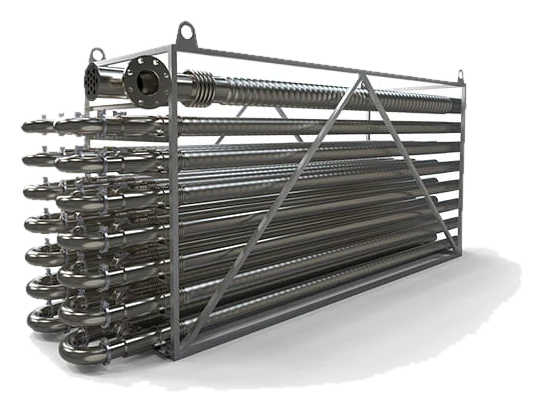
Roughly triple the molybdenum of 316LAt 6 to 7 percent molybdenum with nitrogen, AL-6XN resists the pitting and crevice attack that hot brines and seawater cause in 316L and duplex.
AL-6XN properties for tube-in-tube service
Commonly cited values for this super-austenitic grade and what they mean on a tube-in-tube. Allowable stresses for the wall calculation are taken from the code.
| Property | Detail |
| Composition | About 24% nickel, 20-22% chromium, 6-7% molybdenum, with nitrogen |
| PREN | Commonly cited in the mid-to-high forties |
| Structure | Fully austenitic; non-magnetic when annealed |
| Chloride cracking | Highly resistant; far better than 304L and 316L |
| Strength | Higher than 316L, thanks to the nitrogen |
| Sanitary use | Polishes and electropolishes like 316L; tri-clamp construction |
| Welding | Over-alloyed nickel-base filler protects weld corrosion resistance |
| Usual jacket | 316L on sanitary units; carbon steel on some industrial units |
Duties that justify AL-6XN
The grade pays for itself where a cheaper stainless would pit through in service and titanium would be unsuitable or more than the duty needs. Sanitary brine chillers, salted sauce lines and fish or seafood brines are the typical food cases. On the industrial side, seawater-cooled process coolers, phosphoric acid contaminated with chloride and bleach-plant filtrates appear on the list.
- Pickle, olive, soy and seafood brines
- Seawater and brackish water cooling
- Acidic chloride process streams
- Bleach-plant filtrates and washer streams
When titanium is the better buy
Titanium wins in strongly oxidizing chloride chemistry: wet chlorine, strong hypochlorite and hot, chlorinated seawater. It is also lighter and is usually specified with a thin wall. AL-6XN wins where the stream has a reducing acid character that titanium does not tolerate, and where the plant wants an austenitic stainless it already knows how to weld, inspect and polish.
- Oxidizing chloride chemistry: lean toward titanium
- Traces of reducing acid: lean toward AL-6XN
- Sanitary polish and tri-clamp: AL-6XN is simpler
- Fluorides present: ask about nickel alloys
Specifying AL-6XN correctly
Crevices are where severe chlorides start
A high PREN protects open surfaces best. Crevices under gaskets, deposits and tight joints concentrate chloride and acid, and attack begins there long before the open tube shows anything. Tube-in-tube construction helps, because a welded product path removes most gasketed crevices, but sanitary clamp joints and any product that leaves deposits still need attention. Critical crevice temperature, not pitting resistance alone, is what we compare when choosing between AL-6XN and titanium for a hot brine.
Welding and finishing the alloy
Molybdenum segregates as weld metal solidifies, leaving parts of an autogenous weld leaner in molybdenum than the tube around it. To keep the joint as resistant as the base metal, welds are made with an over-alloyed nickel-base filler, and heat tint is removed so the surface passivates evenly. Sanitary product surfaces are then polished or electropolished to the same specification used for 316L, so the grade drops in to an existing hygienic plant without new cleaning procedures.
What we need to choose the grade
Send the chloride concentration across its full range, the pH, the maximum product and wall temperatures, and whether oxidizers such as hypochlorite or peroxide are present in the product or the cleaning program. With that, we can show whether AL-6XN is the right rung, whether duplex would do, or whether titanium or a nickel alloy is the safer buy.
Call and talk it through with an engineer: 1-805-484-2992
AL-6XN against the alternatives
Yes. It is austenitic, polishes like 316L and takes the same sanitary construction, so it is a common choice for product tubes carrying pickle, olive, cheese and seafood brines. It resists the pitting those brines cause in 316L, especially when they are heated or recirculated for long periods. Clamp gaskets and other elastomers should be checked against the brine as well.
AL-6XN has substantially higher pitting resistance and better crevice resistance, so it holds on where hot seawater or concentrated brine would attack duplex. Duplex is stronger and less expensive, and it is often enough for produced water and moderate brines. The decision usually rests on chloride level and temperature together, with any sanitary requirement favoring AL-6XN.
At low concentration and moderate temperature, often yes, which is why the grade appears in bleach-plant service. As oxidizer strength and temperature rise, titanium generally becomes the more reliable choice. These duties are chemistry-specific, so we judge them from the actual concentration and temperature profile, upset conditions included, rather than from a general rating.
The cost is in the alloy: roughly double the nickel and about three times the molybdenum of 316L, both expensive elements, plus smaller mill volumes and the nickel-base filler needed at the welds. On a tube-in-tube the jacket usually stays 316L or carbon steel, so the premium falls mainly on the product tube, where the alloy is doing the work.
Related
Heat Exchangers
Titanium
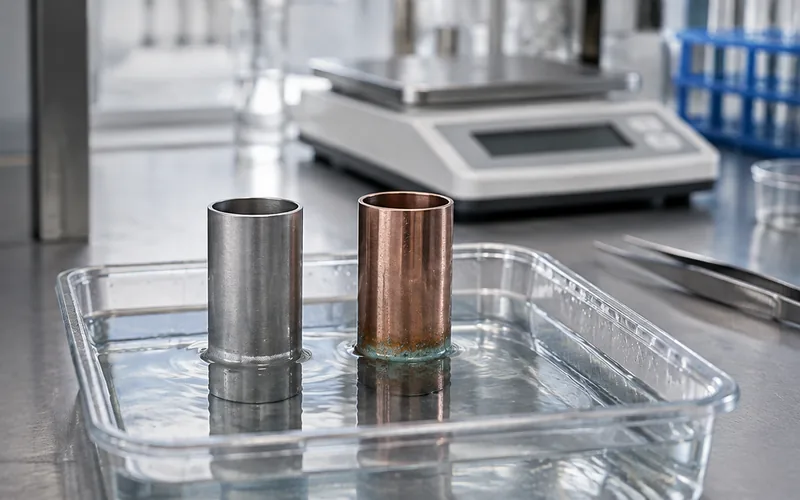
Titanium tube-in-tube heat exchangers for seawater, chloride brines, wet chlorine and oxidizing acids - and the reducing acids and fluorides to avoid.
+ Learn More
Heat Exchangers
316L Stainless
316L stainless tube-in-tube heat exchangers: the sanitary standard, with molybdenum for chloride pitting resistance, low carbon for welds, polished finish.
+ Learn More
Heat Exchangers
304L Stainless
304L stainless tube-in-tube heat exchangers: the lower-cost sanitary grade for low-chloride foods and hot water service, and where 316L is the safer buy.
+ Learn More