
1-805-484-2992
Quotes - Engineering - SalesTwo phases, twice the strength
Austenite and ferrite in roughly equal measure
2205 is a duplex stainless steel: about 22 percent chromium, 5 percent nickel, 3 percent molybdenum and a deliberate nitrogen addition, balanced so the microstructure is roughly half austenite and half ferrite. The ferrite brings strength and resistance to chloride stress-corrosion cracking; the austenite brings toughness and weldability. The result has about twice the yield strength of 316L and a pitting resistance number in the mid thirties.
On a tube-in-tube the strength matters as much as the corrosion resistance. For a given pressure and diameter, a 2205 tube can carry a thinner wall than 316L, which offsets part of its higher price per pound and trims the wall's resistance to heat flow. That makes it a natural fit for double pipe sections on produced water, hot brines and pressurized chloride service, where 316L would either crack or need a heavy wall.
It is the first upgrade above 316L when the problem is hot chlorides under stress: brine heaters, produced water coolers, pulp mill liquors, desalination reject and chloride-bearing caustic. It is not the answer to everything. Duplex has a firm upper temperature limit, its toughness falls at very low temperature, and its welds need tighter control than an austenitic grade, so it is chosen deliberately rather than as a blanket upgrade.
Request a Quote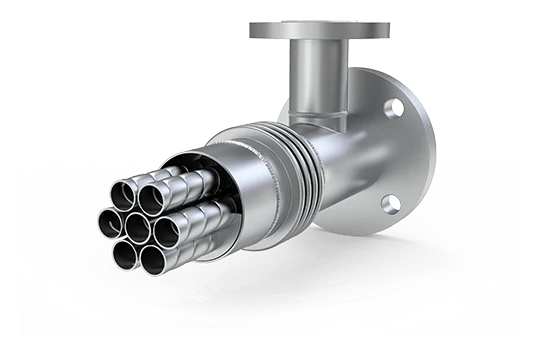
Strength that thins the wallWith about 2 times the yield strength of 316L, a 2205 tube holds the same pressure with less wall, so part of the alloy premium is paid back.
2205 duplex properties for exchanger tube
Figures commonly cited for 2205 and how they apply on a tube-in-tube. Design allowables come from the pressure code at the design temperature.
| Property | Detail |
| Composition | About 22% chromium, 5% nickel, 3% molybdenum, with nitrogen |
| Microstructure | Roughly equal parts austenite and ferrite |
| PREN | Commonly cited around 35 |
| Yield strength | About twice that of 316L |
| Chloride cracking | Far more resistant than 304L or 316L |
| Upper temperature | Pressure-code use limited to about 600 F to avoid embrittlement |
| Low temperature | Toughness falls off when very cold; check impact requirements |
| Usual jacket | Carbon steel or 316L, depending on the service fluid |
Streams that call for 2205
Duplex earns its place where chlorides, heat and pressure meet. Produced water off a separator, hot process brines, sour water carrying chlorides, white and green liquor in a pulp mill, and brine reject from desalination all combine conditions that crack or pit 316L. In each case the higher strength helps too, because these streams tend to arrive at pressure and often carry abrasive solids.
- Produced water coolers and heaters
- Hot salt and process brines
- Pulp mill liquor heating and cooling
- Chloride-bearing caustic and sour water
Limits to respect
Above about 600 F, long exposure lets the ferrite decompose into brittle phases, the effect usually called 885 F embrittlement, so duplex is kept out of very hot service. Holding it too long in roughly the 1300 to 1800 F range during fabrication can form sigma phase, which costs both toughness and corrosion resistance. The most severe hot chloride and acid service goes to AL-6XN, titanium or a nickel alloy.
- No long service above about 600 F
- Controlled weld heat input and interpass temperature
- Impact toughness checked for cold service
- Severe hot acids moved to a higher alloy
Designing and building with duplex
Why the weld procedure matters
The phase balance lives or dies at the weld. Too little heat input cools the joint fast and leaves it ferrite-rich and brittle; too much, or too long at temperature, invites sigma phase and other intermetallics. Qualified procedures use a filler metal over-alloyed in nickel to restore austenite in the weld, nitrogen in the shielding gas, and controlled heat input and interpass temperature. Ferrite content is checked during procedure qualification so the joints match the corrosion resistance of the tube.
Thinner walls and what they change
Because allowable stress is higher, the code calculation for a duplex tube at a given pressure returns a thinner wall than for 316L. That reduces weight and alloy cost and slightly lowers the wall's resistance to heat flow, though on most fluids the film coefficients, not the wall, govern the overall coefficient. Erosion and corrosion allowances still apply on abrasive streams, so the thinnest permitted wall is not always the one chosen.
Duplex in industrial tube-in-tube service
The usual pattern is a 2205 product tube carrying the brine or produced water, inside a carbon steel or 316L jacket carrying the utility. Flanged double pipe sections in pipe sizes suit high-pressure oilfield and process duties, and the same alloy works on a corrosive slurry where erosion and chlorides act together. Send us the chloride level, pH, temperature, pressure and any H2S, and we will confirm whether duplex covers the duty.
Call and talk it through with an engineer: 1-805-484-2992
Is duplex right for this stream?
No. It is stronger and far more resistant to chloride cracking and pitting, but it costs more, its welds need tighter procedure control, and it can not run for long periods above about 600 F. For a clean food duty at moderate temperature, 316L remains the sensible choice; duplex is for hot, chloride-bearing or high-pressure streams where 316L would be living on borrowed time.
Duplex is used in many sour, chloride-bearing oilfield streams, but suitability depends on H2S partial pressure, chloride level, pH, temperature and the hardness limits the material must meet. Those limits come from the sour-service standard your project follows. Give us the gas analysis and the water chemistry and we will confirm the grade against them, or move up to a higher alloy.
When chloride level and temperature together move beyond the pitting and crevice margin of duplex, as with hot seawater, concentrated brines or acidic chloride streams. AL-6XN is the usual next step for sanitary or mixed acidic service; titanium is preferred for seawater and oxidizing chlorides such as hypochlorite. Fluorides or reducing acids in the stream point instead to a nickel alloy.
Not usually. The jacket only sees the service fluid, so carbon steel suits steam, thermal oil and treated water on industrial units, and 316L suits sanitary or outdoor installations. The dissimilar weld where a duplex tube meets a carbon steel jacket closure is a standard joint, made to a qualified procedure with a filler chosen for that pair of metals.
Related
Heat Exchangers
AL-6XN
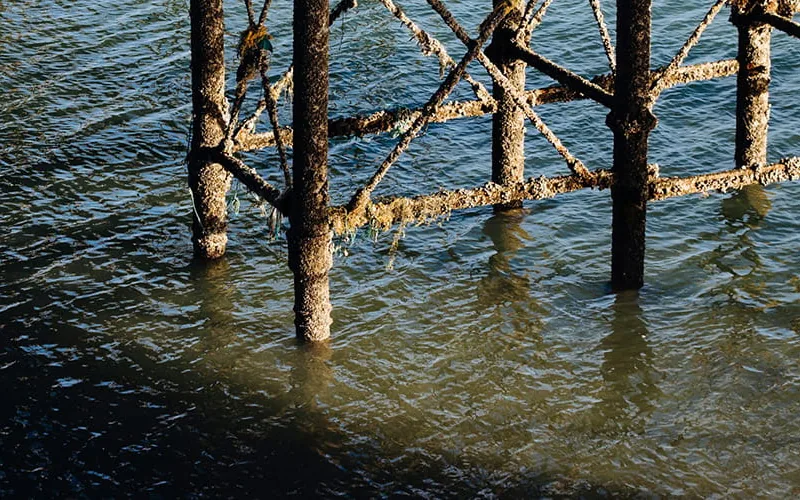
AL-6XN super-austenitic tube-in-tube heat exchangers for seawater, high-chloride brines and acidic chloride streams, and when titanium is the better pick.
+ Learn More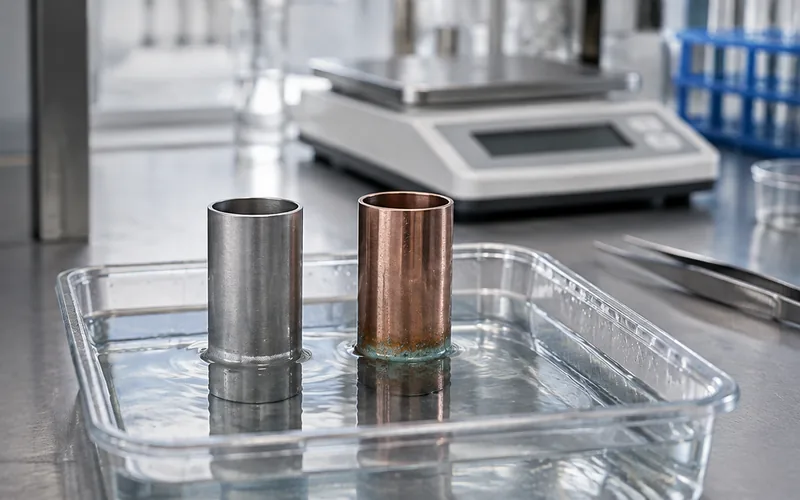
Heat Exchangers
Titanium
Titanium tube-in-tube heat exchangers for seawater, chloride brines, wet chlorine and oxidizing acids - and the reducing acids and fluorides to avoid.
+ Learn More
Heat Exchangers
316L Stainless
316L stainless tube-in-tube heat exchangers: the sanitary standard, with molybdenum for chloride pitting resistance, low carbon for welds, polished finish.
+ Learn More
