
1-805-484-2992
Quotes - Engineering - SalesCooling the batch without losing the texture
Lotions, creams, conditioners, shampoos, gels and toothpaste
Most creams and lotions are made hot. The oil and water phases are heated above the melting point of the waxes and emulsifiers, combined under high shear, and then cooled. In a jacketed kettle that cooling is often the slowest step of the whole batch, because heat transfer through the jacket falls off as the product thickens. Moving the cooling into an in-line tube-in-tube shortens the cycle and frees the kettle for the next batch sooner.
Cooling is also where the texture is made. As an emulsion passes through the range where its waxes crystallize, its internal structure sets and viscosity climbs, so product leaving the exchanger may be far thicker than product entering. Cool too fast, or work it too hard through that range, and a cream can come out thin, grainy or prone to separate. Conditioners and pearlized shampoos have the same sensitivity to how they are cooled.
A tube-in-tube gives a low, predictable shear and an even cooling profile along its length, with true counterflow so the product approaches the coolant temperature gradually. The product path is sanitary 316L, polished or electropolished, with clamp ends and no dead zones. It drains fully and is cleaned in place, which matters in a plant that changes shade or fragrance several times a day.
Request a Quote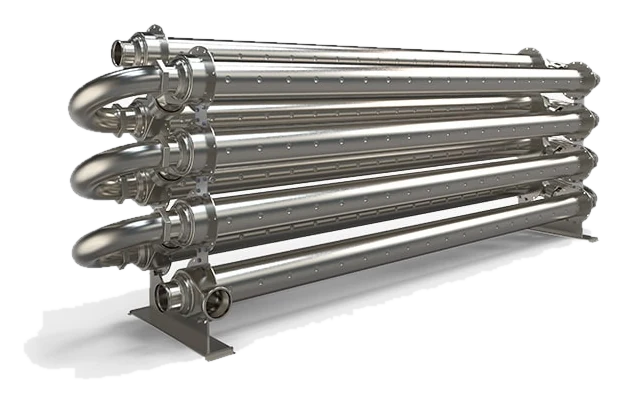
Structure forms in the cooler, so the cooler shapes it
Cooling rate and shear through the wax-setting range decide the final viscosity and skin feel of a cream; the exchanger is part of the formula, not only a utility.
Personal care products by behavior
Emulsions
- Creams, lotions, body butters and sunscreens
- Cooled through the wax-setting range
- Heavy working while setting can thin them
- Thick at fill temperature
Surfactant systems
- Shampoos, body washes and conditioners
- Viscosity built by salt and micelle structure
- Air entrainment at high velocity
- Pearlizing agents need controlled cooling
Gels and pastes
- Clear gels, serums and toothpaste
- Polymer gels thin under shear, then recover
- Trapped air spoils clarity
- Abrasive pastes favor a smooth full bore
Fitting the design to the formula
The choice turns on how much the product thickens as it cools and how much shear it can take while it sets.
| PRODUCT / DUTY | DESIGN | WHY IT FITS |
| Creams and lotions after emulsification | Tube-in-Tube | Even, low shear in a single bore lets the emulsion set as it cools without being overworked. |
| Very thick creams and butters | Triple-Tube | Two cooling surfaces on a thin annulus shorten the run where product stiffens sharply. |
| Shampoo and body wash | Multi-Tube | Smooth surfactant products with nothing to bridge gain surface per foot from several tubes. |
| Shear-sensitive serums and gels | Concentric Tube | Product carried in a wide annulus meets gentle flow over a generous heat transfer area. |
| Pilot batches and skid lines | Ultra-Coil | Compact coil with small hold-up keeps product loss low between shades and fragrances. |
Moving the cooling out of the kettle
Kettle cooling slows as the batch thickens. Jacket heat transfer depends on the product film at the vessel wall, and that film gets worse with every degree the cream loses. The final part of a kettle cool-down is usually the slowest. Pumping the hot emulsion through an in-line tube-in-tube to a holding tank or the filler changes the picture: the product sees a fresh, controlled cooling surface all the way down, and the kettle is ready for its next batch.
Shape the cooling profile. Tempered water through the wax-setting range, then colder water to reach fill temperature, mirrors what a careful kettle operator does by hand. An abrupt cold wall can set a skin of wax on the tube that sheds as specks or a grainy feel. Counterflow lets the product finish close to the coolant temperature without the coolant ever being much colder than the cream beside it.
Expect the pressure at the outlet. Because structure builds as the product cools, the last sections of the exchanger carry most of the pressure drop, and a positive displacement pump is the usual choice. Many lotions and gels are also thixotropic: they thin while moving and stiffen at rest. A viscosity test across the cooling range, plus a reverse sweep to show the rebuild after standing, tells us the running and the restart pressure.
Call and talk it through with an engineer: 1-805-484-2992
Plant details for personal care
Shade and fragrance changeovers
Color and fragrance carryover show up instantly in the next batch, so the exchanger must empty and clean completely. A drainable unit, a water push to recover product and CIP with chemistry suited to oils and surfactants handle most changeovers. Electropolished product surfaces release creams more readily and shorten the rinse.
Microbial control
Water-based lotions and shampoos are good growth media until their preservative system takes hold. Dead legs, pockets that never drain and threaded joints are where contamination starts. Welded construction, clamp ends, full drainability and hot water or steam sanitizing of the product side keep the exchanger off the list of suspects.
Air and foam
Surfactant products whip air in at high velocity or in partly filled tubes, and clear gels lose clarity with every bubble. Keeping the tubes full under back pressure, feeding the exchanger outlet below the liquid level in the receiving tank and holding velocity moderate keep the product clear and it's fill weight steady.
Materials and elastomers
316L is the standard product tube. Shampoos thickened with sodium chloride carry chlorides, which is one more reason not to step down to 304L there. Clamp gaskets should be FDA-compliant elastomers checked against your fragrance oils and surfactants, since some swell or leach in strong essential oils.
Cream and lotion cooling
It can, and often more consistently, because every portion of the batch sees the same cooling path instead of whatever the jacket and agitator gave it. The cooling profile has to match what your formula expects through the wax-setting range. A trial on a sample, checked for viscosity and feel against kettle product, is the sensible way to confirm it before committing.
Yes. Toothpaste is thick and carries abrasive silica or calcium carbonate, so a smooth full-bore tube with no tight clearances suits it better than narrow channels. Pressure drop is the governing limit, and the design usually uses larger bores, shorter parallel paths and a positive displacement pump. Expect a test of the paste across its temperature range before final sizing.
Keep the exchanger full and under some back pressure, so no tube runs partly empty. Hold velocity moderate, avoid sudden expansions at the outlet, and discharge into the receiving tank below the liquid surface. If air enters upstream at the mixer, the exchanger will carry it through, so deaeration belongs before the cooler, not after it.
Not as a rule. 3-A is a dairy and food sanitary standard, and personal care plants generally specify sanitary design without the 3-A symbol: polished 316L, clamp ends, drainability and CIP. We can supply a unit built to 3-A where your quality group wants that level of documentation, for example in a plant that also runs food products.
Related
Sanitary
Thick Sauces & Condiments
Tube-in-tube heat exchangers for ketchup, mustard, BBQ and cheese sauce and mayonnaise, sized on viscosity and pressure drop for hot fill and cooling.
+ Learn More
Sanitary
Salad Dressings
Tube-in-tube heat exchangers for salad dressings: low-shear cooling after the mixer, 316L for vinegar and salt, and herbs and spices passed intact.
+ Learn More
Sanitary
Sweeteners & Sugars
Tube-in-tube heat exchangers for honey, glucose and corn syrup, liquid sugar and molasses: heating to pump, cooling after evaporation, no crystal buildup.
+ Learn More
