
1-805-484-2992
Quotes - Engineering - SalesSyrups that thicken as fast as they cool
Honey, glucose and corn syrups, liquid sugar, invert syrup and molasses
One property dominates the thermal design of a sugar syrup: viscosity that rises steeply as temperature falls and as Brix goes up. A high-Brix glucose syrup or a honey that pumps easily when warm can be many times thicker a few dozen degrees cooler. Unlike sauces and creams, most clear syrups are close to Newtonian, so the challenge is not shear behavior. It is extreme sensitivity to temperature and to small changes in concentration.
The duties follow from that property. Syrups are heated so they can be pumped, filtered or blended; they are cooled after evaporation so they can be stored without darkening; honey is warmed gently to dissolve crystals and ease straining. Each of these duties runs into a limit at the wall. A hot wall browns sugar and changes flavor, and a cold wall grows crystals that stick, insulate and choke the flow.
A tube-in-tube gives the control these products need. Hot or tempered water in the annulus holds the wall close to the product temperature, true counterflow lets the syrup approach the utility without a large driving difference, and the round tube tolerates the high pressure drop that a cool, thick syrup generates. Sanitary units come in 316L with clamp ends; heavier feed and industrial syrups can go in flanged pipe-size sections.
Request a Quote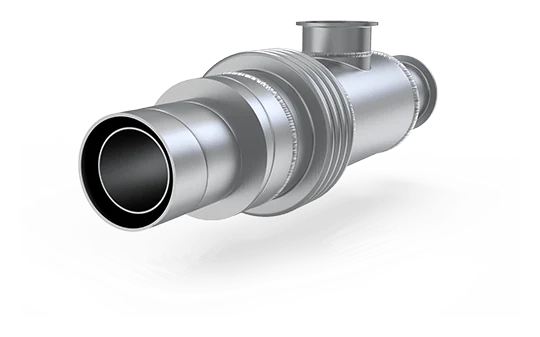
Syrup viscosity climbs steeply with every degree of cooling
Size a syrup cooler on the viscosity at its outlet temperature and actual Brix; the final sections carry most of the pressure drop and therefore set the pump.
Three syrup duties and their risks
Heating to pump
- Warm tank or tote product before transfer
- Hot water in the annulus, not raw steam
- Wall temperature limits browning and flavor change
- Inlet viscosity decides the pump
Cooling after evaporation
- Hot concentrate leaving the evaporator
- Staged: tower water, then chilled water
- A cold wall can seed crystals
- Pressure drop grows along the cooler
Honey and specialty syrups
- Gentle warming to dissolve crystals
- Overheating darkens color and dulls aroma
- Fine wax and pollen pass the round bore
- Low hold-up for small, varied batches
Which design suits which syrup
Syrups range from free-running liquid sugar to molasses that barely moves when cold. The design follows the viscosity at the coldest point in the unit.
| PRODUCT / DUTY | DESIGN | WHY IT FITS |
| High-Brix glucose and corn syrup | Tube-in-Tube | A full-bore tube keeps pressure drop manageable where cooled syrup becomes very thick. |
| Liquid sugar and invert syrup | Multi-Tube | Thinner, clean solutions gain surface per foot from several small tubes inside one jacket. |
| Molasses and heavy blends | Triple-Tube | Heat applied from both sides of a narrow annulus shortens the run on very thick syrup. |
| Feed molasses and industrial syrups | Double Pipe | Flanged pipe-size sections in carbon steel or 316L take the pressure a cold, thick syrup demands. |
| Honey warming before straining | Ultra-Coil | A compact coil with a close hot-water approach and low hold-up suits smaller honey lines. |
Crystals, color and the wall temperature
Crystals start at the coldest surface. A high-Brix syrup cooled toward saturation crystallizes first where it is coldest, which is the tube wall. Dextrose-rich syrups and honey are especially prone. The crystals stick, add thermal resistance and narrow the bore, so a cooler that met its outlet temperature on Monday is falling short by Friday. Limiting the gap between coolant and syrup at the outlet end, with tempered water rather than very cold glycol, keeps the wall above the point where crystals take hold.
Color and flavor are made at the hot wall. Sugars brown through caramelization and, where proteins or amino acids are present, Maillard reactions. Both speed up with temperature and time. In laminar flow the layer against a heated wall moves slowest, so it collects the most heat. Steam on the annulus makes the problem worse. Hot water at a modest approach, heating only as far as pumping or filtration requires, keeps color and aroma where the product specification wants them.
Brix sets every property. Viscosity, density, specific heat and crystallization point all shift with Brix and temperature together. A syrup that runs a point or two higher on some shifts can be noticeably thicker, so design for the full Brix range, not the nominal value. Send the Brix range, flow and temperatures, or a sample for viscosity testing, and we will size it on measured figures.
Call and talk it through with an engineer: 1-805-484-2992
Syrup plant details that matter
Restarting after a cold night
Syrup left in the tubes over a shutdown cools to room temperature and can be too thick for the pump to move. The cure is procedural as much as mechanical: circulate hot water through the annulus first to warm the product, then start the pump. We check the design pressure for that restart case so nothing is overstressed if someone skips the step.
Rinsing sugar out
Sugar dissolves readily in warm water, so a hot rinse removes most of the residue before CIP even starts. What it leaves behind is the real risk: a thin film in a dead leg feeds osmophilic yeasts and molds. A fully drainable unit with no dead zones and a proper CIP cycle closes that door.
Pumps and connection ratings
Positive displacement pumps are the norm on thick syrups and can generate high pressure against a cold line. Sanitary clamp joints carry lower pressure ratings than welded or flanged joints, so a high-pressure syrup duty may call for flanged sections or a relief setting matched to the weakest joint.
304L or 316L
Refined sugar solutions are low in chlorides, and 304L serves many of them well at lower cost. Molasses carries much more ash, including chlorides, and blended syrups may contain acids. For those streams, and for plants that clean with chlorinated chemistry, 316L is the safer choice.
Syrup cooler and heater questions
The most likely cause is crystal growth on the cold end of the tubes. Each layer adds resistance and narrows the bore, so outlet temperature creeps up and pressure drop rises together. Raising the coolant temperature at the final section, or staging the cooling so no section runs a large gap between coolant and syrup, usually stops the buildup. A hot water flush clears what is already there.
Not directly. Steam puts a wall temperature far above what honey tolerates, and the slow layer at the wall darkens and loses aroma long before the bulk reaches its target. Hot water at a modest approach, with the honey heated only as far as straining or filling needs, protects color and flavor.
Sometimes not. For a plain sucrose solution, published viscosity data at a given Brix and temperature is reliable. Glucose syrups vary with DE, honey varies by floral source and moisture, and blends with starches or gums can behave very differently. For those products a viscosity test across the temperature range is cheap insurance against an undersized cooler.
Fine pollen and wax pass a full-bore tube easily. A drum of honey that has granulated is another matter: a mass of crystals behaves like a paste and drives pressure drop far above the liquid figure. Warm it in the drum or tank until it flows, and let the exchanger finish the job. Sizing on liquid honey and then feeding the unit set honey is a common way to stall the pump.
For refined liquid sugar and similar low-chloride solutions, 304L is generally acceptible and costs less. The choice changes if the line also handles molasses, acidified syrups or salty blends, or if the plant sanitizes with chlorinated chemicals. In those cases 316L avoids pitting that would otherwise appear first at welds and under deposits.
True counterflow allows a close approach, and on a clean, low-Brix solution a tight approach is practical. On high-Brix syrups the limit is usually crystallization rather than heat transfer: the coldest wall must stay above the point where crystals start. That often means accepting a slightly warmer outlet, or adding lenght so tempered water can finish the job.
Related
Sanitary
Cosmetics & Personal Care
Tube-in-tube heat exchangers for lotions, creams, shampoos and gels: low-shear cooling after emulsification in sanitary 316L built for CIP between batches.
+ Learn More
Sanitary
Thick Sauces & Condiments
Tube-in-tube heat exchangers for ketchup, mustard, BBQ and cheese sauce and mayonnaise, sized on viscosity and pressure drop for hot fill and cooling.
+ Learn More
Sanitary
Salad Dressings
Tube-in-tube heat exchangers for salad dressings: low-shear cooling after the mixer, 316L for vinegar and salt, and herbs and spices passed intact.
+ Learn More
