
1-805-484-2992
Quotes - Engineering - SalesPulp, fiber and acid in one product stream
Purees, tomato products and fruit preparations
Fruit and vegetable products are hard on heat exchangers in three ways at once. They carry fiber and pulp that mat across narrow channels, they are acidic, and they lose color and flavor quickly when held hot too long. Apple, pear, peach and mango purees, banana and berry bases, pumpkin and carrot purees, tomato pulp and paste, and fruit preparations with visible pieces all bring some mix of the three to the exchanger.
A plate copes with a filtered, clear juice. Add pulp and the contact points collect fiber until pressure drop climbs and the line stops for an early clean. A tube-in-tube has no contact points at all. Fiber travels through the bore with the product, and the length of a run is set by slow fouling on the wall rather than by sudden plugging.
Most fruits are acidic enough that pasteurization, rather than full sterilization, makes them shelf stable, which keeps process temperatures moderate. Tomato sits close to the boundary and is often acidified. Carrot, pumpkin and squash purees are low-acid and go to an aseptic or retort process, where the same bore and material reasoning still applies.
Request a Quote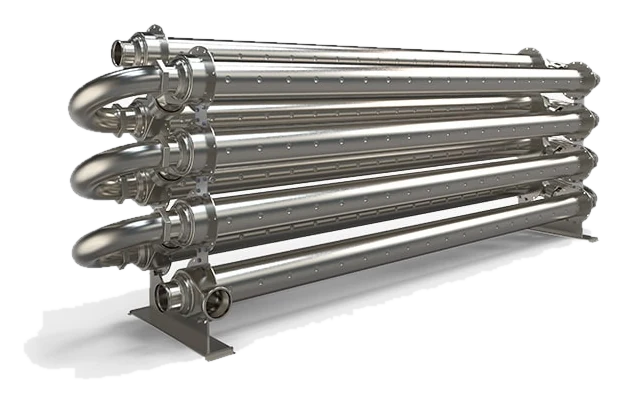
Hot break sets tomato viscosity in seconds
Crushed tomato heated quickly to near 200 F stops the fruit's own enzymes from breaking down pectin, keeping the body that paste and ketchup need. Heat it too slowly and the enzymes win.
Fruit and vegetable duties
Fruit purees
- Apple, pear and peach puree pasteurizing
- Mango and banana puree for aseptic drums
- Berry purees with seeds left in
- Fruit blends for baby food
Tomato products
- Hot-break and cold-break heating
- Tomato pulp ahead of the evaporator
- Paste cooling after concentration
- Diced tomato in juice
Preparations and vegetables
- Fruit preparations with pieces for yogurt
- Pie fillings and dessert toppings
- Carrot, pumpkin and squash purees
- Pepper and vegetable sauce bases
Which design fits each fruit product
Fiber length, piece size and paste thickness each point toward a different geometry, and many plants run two of them on the same line.
| PRODUCT / DUTY | DESIGN | WHY IT FITS |
| Tomato hot break | Tube-in-Tube | A full bore takes crushed tomato with skins and seeds and heats it fast enough to stop enzyme action |
| Smooth fruit puree | Multi-Tube | Finished puree with fine pulp passes the smaller bores, which add surface for long campaigns |
| Tomato paste after the evaporator | Triple-Tube | Very thick paste is cooled from both sides of a thin annular layer, cutting the length needed |
| Fruit preparation with pieces | Tube-in-Tube | Whole berries and fruit dice travel the single bore intact and come out recognizable |
| Puree cooling in a tight room | Ultra-Coil | A coiled layout gives close-approach cooling in little floor space for fine-pulp purees |
Tomato breaks, puree acidity and cooling after the hold
Hot break and cold break. Tomato pectin is attacked by the fruit's own enzymes as soon as it is crushed. A hot break heats the crushed tomato to around 185 F to 200 F within seconds to stop them, keeping the viscosity that paste, ketchup and sauce depend on. A cold break runs nearer 140 F to 160 F and keeps more color and fresh flavor but gives a thinner product, better suited to juice. Either way the heater takes whole crushed fruit with skins and seeds and must heat it fast, which makes it a full-bore duty.
Acid and the material. Fruit acids on their own are mild on stainless steel, but purees often arrive with added salt, chloride from the process water or acidified vegetables, and that combination attacks lower grades. 316L is the standard on these lines. Hot acidic product also rules out carbon steel anywhere in the product path, and clamp gaskets are chosen for the acidity and the cleaning chemistry together.
Cooling after pasteurization. Fruit puree held hot loses color and picks up cooked notes, so the cooler after the hold matters as much as the heater. Counterflow brings product close to coolant temperature in one pass, and a regenerative section, where cold incoming puree takes heat from hot outgoing puree, saves both steam and chilled water on products that tolerate it.
Call and talk it through with an engineer: 1-805-484-2992
Running fiber and pulp day to day
Fiber length and fouling
Citrus pulp and tomato fiber are short and pass any sensible bore. Long fibers, such as stringy mango or celery, behave differently and wrap around anything that sticks into the flow. A smooth bore with welded joints and clamp ends outside the product path gives them nothing to wrap. Fouling then comes from pectin and sugar baking onto the wall, which a controlled wall temperature keeps in check.
Seeds and skins
Berry seeds, tomato skins and pepper fragments are small but hard, and they collect wherever velocity drops. Most plants finish or screen purees before heating, which helps, but whole crushed tomato reaches the hot break with all of it. The bore and the CIP velocity are set so these pieces are carried out rather then left behind in a return bend.
Seasonal campaigns
Tomato and many fruit lines run hard for a few months and then stand idle. An exchanger that drains completely and is cleaned and dried at the end of the season avoids the corrosion and microbial growth that begin in standing water. Size for the peak flow of the campaign, then confirm that one bank still runs well at the lower flows of any off-season products.
Color and nutrient loss
Color pigments and vitamin C in fruit break down with time at temperature, not only with peak temperature. A short, even residence in a full bore, with no stagnant pockets where some product lingers far longer than the rest, gives the whole batch the same thermal history. Even flow matters more here than an extra degree on the hold.
Purees, pulp and tomato lines
It can, since the difference is mainly the outlet temperature and how fast it is reached. The hot break is the harder duty because it must heat faster, so a unit sized for hot break covers cold break with cooler heating water. Check that the controls can hold the lower setpoint steadily, which is where shared units sometimes struggle.
Pulp and fiber catch on the contact points between plates, and once a mat forms it traps more pulp and bakes on the hot side. Pressure drop rises and run time shortens with each batch. A tube has no contact points, so the run is limited by wall fouling alone, which is slower and far more predictable.
For a low-salt fruit puree it often is, and it costs less. The risk comes with salt, chloride in the water supply or acidified vegetable products, all of which push toward pitting. Most fruit and vegetable plants specify 316L so that one unit can run any product on the schedule without a material question each time.
We size on the thickest batch the line will run, at the coldest point in the exchanger, using measured viscosity wherever possible. Fruit maturity, variety and finisher screen size all move puree viscosity, so one figure from a single batch can mislead. A sample tested across the temperature range gives the band to design within.
Related
Sanitary
Beverages
Beverage heat exchangers in tube-in-tube form for pulpy juice, juice with sacs, smoothies, oat and plant-based drinks and concentrates, hot fill included.
+ Learn More
Sanitary
Aseptic & UHT Products
Aseptic heat exchangers in tube-in-tube form for UHT and low-acid foods with particulates: heating to sterilizing temperature, aseptic cooling and SIP.
+ Learn More
Sanitary
Dairy
Tube-in-tube heat exchangers for dairy: stirred yogurt after the break, puddings, cheese sauce, fruit preparations and high-solids milk concentrates.
+ Learn More