
1-805-484-2992
Quotes - Engineering - SalesHeating without burning the product on the wall
The utility sets the wall temperature the product sees
A heating duty looks simple on paper: product in, a utility hotter than the product in the annulus, product out at temperature. The difficulty is at the wall. The tube surface runs close to the utility temperature, not the product temperature, and a protein, starch or sugar-rich product that touches a wall much hotter than itself will denature, caramelize or scorch there. The deposit then insulates the tube, the outlet temperature falls, and the control valve opens further and makes the wall hotter still.
Tube-in-tube heaters give the designer three levers against that spiral: the utility, its temperature and the product velocity. Steam heats fastest and runs the wall hottest. Hot water lowers the wall temperature and makes control smoother. Thermal oil reaches temperatures above 600 F without the very high pressure steam would need there. The product side is sized for a velocity that keeps a thin, moving film at the wall, which is the best defense against burn-on.
Heating is the first step on many lines: bringing a sauce up to fill temperature, raising a resin until it will pump, or taking product toward a pasteurizing or sterilizing hold. This page covers the heater itself; the hold and the cooling that follow have their own process pages.
Request a Quote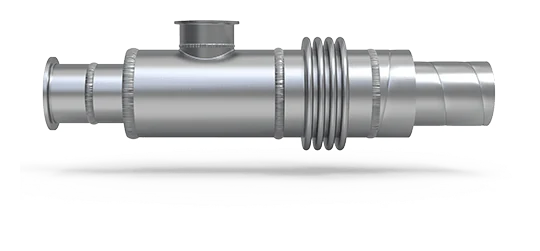
A deposit of denatured protein, caramelized sugar or scorched starch that forms where product touches a heating wall much hotter than itself; it insulates the tube and grows until the line is cleaned.
Heating media compared
The common utilities in the annulus and what each means for the product side. Plant steam pressure, oil supply temperature and hot-water set capacity are the first things we ask about.
| Utility | Detail |
| Low-pressure steam | Highest film coefficient; wall near steam temperature, about 250 F at 15 psig |
| Steam at 150 psig | About 366 F; strong heating and a high wall temperature |
| Hot water | Wall held close to water temperature; smooth control, gentle on sensitive products |
| Tempered water loop | Steam-heated water recirculated at a set temperature to cap the wall |
| Thermal oil | Above 600 F at low pressure; lower film coefficient than condensing steam |
| Product-to-product | Hot outgoing product heats incoming product on heat-hold-cool lines |
| Control | Steam pressure or water temperature in the annulus, trimmed by product outlet temperature |
Steam in the annulus
Condensing steam gives the highest heat transfer of any common utility and the shortest unit. Its temperature is fixed by its pressure, so control comes from throttling the steam, and a throttled annulus can fall below atmospheric pressure, stop draining condensate and stall. A trap sized for the low-load case, a vacuum breaker and a drain at the low point of each section keep the annulus clear.
Hot water in the annulus
Hot water trades some heat transfer for a lower, more even wall temperature, and its control is gentler because the water temperature, not a condensing pressure, sets the driving force. It is the usual choice for dairy-based sauces, egg products, puddings and anything that scorches. The cost is a longer unit and a hot-water set with its own pump and heater.
Thermal oil for high temperature
Resins, waxes, polymers and heavy oils often need temperatures at which steam would demand a very high pressure. Thermal oil delivers that heat at low pressure in the annulus, which keeps the jacket lighter and the system simpler. Its film coefficient is lower than that of steam, so the exchanger runs longer, and the oil's own viscosity at a cold start has to be checked.
Regeneration
On a line that heats, holds and cools, the product leaving the hold still carries most of the heat just put into it. A regeneration section runs that hot product against the incoming cold product, so the heater supplies only the last part of the temperature rise and the cooler has less to remove. In a sanitary regenerator both streams are product, so both channels are built and cleaned to sanitary standards.
Designing a heater that stays clean
Keep the temperature difference modest
The wall-to-product difference drives burn-on. A short heater with a hot utility runs a large difference at the inlet, where the product is coldest, most viscous and its film thickest. A longer heater with a cooler utility does the same duty with a gentler wall. For sensitive products the extra length is cheaper than the cleaning, lost run time and off-flavor that burn-on brings. Counterflow helps, because the hottest utility meets the hottest product at the outlet and the difference stays more even along the tube.
Control that does not hunt
Viscous products respond slowly to a change at the wall, and a controller tuned for water will overshoot. Measuring product outlet temperature and trimming the utility, rather than switching it on and off, keeps the outlet steady. On steam, a pressure controller on the annulus with the outlet temperature resetting its set point is a common arrangement; on hot water, controlling the supply temperature gives the smoothest result. An outlet that swings by several degrees usually points to an oversized valve or a stalled steam annulus, not a short exchanger.
What to send for a heating duty
Send the product and its recipe in general terms, the flow range, inlet and outlet temperatures, viscosity at both temperatures if you have it, the largest particle, and the utility available with its temperature and pressure. Say whether the product scorches, foams or gels, because that decides how gentle the wall has to be.
Call and talk it through with an engineer: 1-805-484-2992
Heater sizing questions
Hot water, in most cases. Cheese sauce carries protein and fat that scorch on a steam-hot wall, and once burn-on starts the heater loses duty through the run. A hot-water annulus with a modest temperature diffrence keeps the wall cleaner. Steam remains an option when runs are short and cleaning follows each batch, but the unit should then carry a generous fouling allowance.
Usually fouling on the product side: burn-on, scale or a settled layer of solids. The outlet temperature drops, the controller calls for more heat, and the wall gets hotter, so the fouling speeds up. Check the wall-to-product temperature difference at the inlet and the product velocity. A gentler utility, or a smaller bore with higher velocity, often cures it.
Yes, with the bore chosen for the largest piece and the velocity kept high enough to carry pieces without damaging them. The center of a piece heats more slowly than the liquid around it, so a heater on a particulate product is followed by a hold long enough for heat to reach the center. That hold belongs to the pasteurization or sterilization design.
Not always, but it is often the simpler answer. Saturated steam at 150 psig is only about 366 F, and higher temperatures need much higher steam pressure and a heavier jacket. Thermal oil reaches above 600 F at low pressure. If plant steam is available at the pressure you need, steam usually gives the shorter, cheaper heater.
By the heat you want to recover against the lenght you are willing to buy. The closer the incoming product gets to the outgoing product's temperature, the more heat is recovered and the longer the section. Viscous products make that trade steeper, because both sides run laminar.
Related

Sizing & Selection
Cooling
Tube-in-tube heat exchangers for cooling viscous and particulate products with tower water, chilled water or glycol, in counterflow for a close approach.
+ Learn More
Sizing & Selection
Pasteurization
Tube-in-tube pasteurizers for products with pieces, pulp or high viscosity: heat, hold and cool sized on the slowest-heating particle, with regeneration.
+ Learn More
Sizing & Selection
Sterilization
Thermal design for tube-in-tube UHT sterilizers: heating to 275-300 F, hold tube length, residence-time distribution, F0 and SIP of the product side.
+ Learn More
