
1-805-484-2992
Quotes - Engineering - SalesWhy concentric tubes carry pressure well
Small bores, no gaskets in the flow path, code-designed walls
Stress in a pressurized tube wall rises with pressure and with diameter, and falls as the wall thickens. A small-bore tube therefore holds a high pressure with a modest wall, while a large shell or a plate frame needs heavy steel, thick heads or tie bars to do the same. That is why double pipe and tube-in-tube units are long-standing choices for small and medium duties at high pressure: the pressure lives in round tubes, not in gaskets or flat plates.
Our industrial units are designed to 1500+ psi, with higher pressures available on custom designs, and to temperatures above 600 F. Connections are flanged in the pressure class the duty calls for, or threaded on small bores. Materials run from carbon steel through 316L, 2205 duplex and titanium to high-nickel alloys, chosen for the chemistry of the fluid as well as its pressure.
This page covers duties where pressure drives the design: supercritical and transcritical carbon dioxide, high-pressure water, hydraulic and test-stand fluids, and process streams fed to reactors or injection systems. Hot oilfield and refinery streams, where pressure comes with fouling or sour service, are covered on the Oil & Gas page.
Request a Quote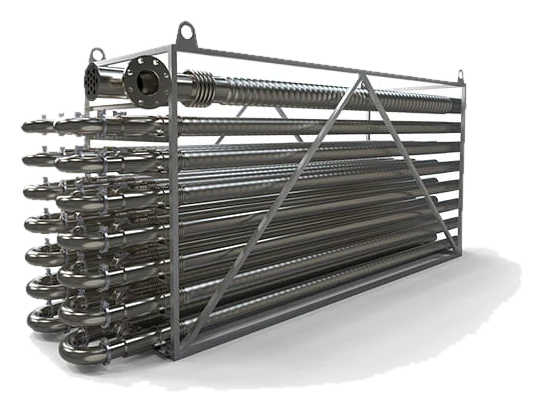
The circumferential stress in a pressurized tube wall, roughly pressure times diameter divided by twice the wall thickness - the reason a small bore holds high pressure with a modest wall.
High-pressure design envelope
The limits and choices that frame a high-pressure tube-in-tube or double pipe. Code calculations set the final wall, and the test pressure follows from them.
| Item | Detail |
| Design pressure | 1500+ psi on industrial units; higher on custom designs |
| Design temperature | Above 600 F on industrial construction |
| High-pressure side | Inner tube by preference; annulus when the duty requires it |
| Connections | Flanged in the required pressure class, or threaded on small bores |
| Materials | Carbon steel, 316L, 2205 duplex, titanium, high-nickel alloys |
| Code | ASME Section VIII with U stamp; National Board registration |
| Pressure test | Hydrostatic test above design pressure, witnessed and recorded |
| Wall basis | Code calculation plus corrosion allowance where the fluid needs it |
Supercritical CO2
Carbon dioxide goes supercritical above about 88 F and 1,070 psi, and extraction, cleaning and power-cycle loops run above both. Near that point its specific heat peaks sharply and its density changes fast, so one average property set badly misjudges the duty. We size these exchangers in increments along the length, with properties recalculated at each step. Heaters ahead of the extraction vessel and coolers ahead of the pump are the typical pair.
Transcritical CO2 gas coolers
In a transcritical refrigeration or heat pump cycle, CO2 rejects heat above its critical point, so it cools in a gas cooler instead of condensing at one temperature. That long temperature glide suits true counterflow: water can leave close to the CO2 inlet temperature, which is what makes CO2 heat pumps good at producing hot water. High-side pressures sit well above 1,000 psi, comfortably inside what a small-bore inner tube carries.
Hydraulic and test-stand fluids
Most hydraulic coolers sit on the return line at low pressure. A tube-in-tube is the right choice when the oil must be cooled or heated on the pressure side: test stands that condition fluid at system pressure, loops with no low-pressure return, or circuits where pressure spikes reach the cooler. The small-bore, all-welded product path takes the pressure, and the annulus carries ordinary cooling water.
High-pressure water and process feeds
Water above its atmospheric boiling point stays liquid only while it is held under pressure, and hot water loops, reactor feeds and injection systems run that way. A process feed heated to reaction temperature at pump discharge pressure is a typical double pipe duty: modest flow, high pressure, and a temperature program that suits counterflow. Feed and reactor effluent can also be paired in the same exchanger to recover heat.
Designing for pressure, temperature and test
Which side carries the pressure
Put the high pressure in the inner tube. Its small diameter needs the thinnest wall for a given pressure, while the larger jacket would need a much heavier one. When both fluids are at high pressure, each side is designed for its own pressure, and the inner tube is also checked against external pressure from the annulus for the case where its own side is drained or under vacuum. A design that checks only internal pressure can buckle the inner tube during a start-up the drawings never considered.
Expansion and pressure cycling
The inner tube and the jacket run at different temperatures, so they grow by different amounts. A U-bend return absorbs that difference, which is one reason the hairpin is the common double pipe arrangement at high pressure. Duties that cycle pressure many times a day - test stands, batch reactors, start-stop loops - add fatigue to the design basis. Tell us the number of cycles and their range, not only the peak pressure.
Test and paperwork
Code units are hydrostatically tested above design pressure - 1.3 times MAWP under the current Section VIII rules - before the stamp is applied, and the code data report records materials, calculations and the test. Where the jurisdiction or the plant requires it, the unit is registered with the National Board. Ask for the documentation package you need at quote stage, so it is priced and scheduled from the start.
Call and talk it through with an engineer: 1-805-484-2992
Before you specify high pressure
Put the fluid with the highest pressure in the inner tube unless something rules it out, such as particulates that need the wider annulus or a fouling stream that must be cleaned from the outside. The inner tube needs the thinnest wall for the pressure, which also keeps cost and weight down. Send both fluids and their pressures and we will propose the arrangement.
Most are, because a vessel at that pressure in a US plant almost always falls inside Section VIII, and the plant's insurer or jurisdiction expects the stamp. Some small-bore designs fall outside the code's scope, but buyers usually want the stamp regardless. Say what your site requires, including National Board registration, and the design and test are built around it.
The connections and the details around them, more often than the tube wall. Gaskets in the wrong flange class, threaded joints on vibrating lines and welds at nozzles are where leaks start. Fatigue from pressure cycling is the other common cause. A welded product path, flange classes matched to design pressure and an honest cycle count in the specification prevent most of it.
Related
Sizing & Selection
Heating
Tube-in-tube heat exchangers for heating: steam, hot water or thermal oil in the annulus, the wall temperature kept in check against burn-on, regeneration.
+ Learn More
Sizing & Selection
Cooling
Tube-in-tube heat exchangers for cooling viscous and particulate products with tower water, chilled water or glycol, in counterflow for a close approach.
+ Learn More
Sizing & Selection
Pasteurization
Tube-in-tube pasteurizers for products with pieces, pulp or high viscosity: heat, hold and cool sized on the slowest-heating particle, with regeneration.
+ Learn More
