
1-805-484-2992
Quotes - Engineering - SalesTube-in-Tube Heat Exchangers – Applications Overview
Tube-in-tube heat exchangers are the ideal choice for applications involving solids, particulates, fibers, and slurries. Their single-pass concentric design provides wide, unobstructed flow paths on both sides, preventing plugging and bridging while maintaining gentle, low-shear handling critical for products with suspended particles or fibrous content.
Key Applications
- Slurries & Particulates: Efficient heating/cooling of abrasive, high-solids slurries, mineral suspensions, chemical pastes, and particulate-laden process streams without blockage or excessive wear.
- Waste Streams: Robust thermal treatment of sewage sludge, industrial effluents, digestate, fibrous wastewater, and dewatering feeds with high dry solids and variable consistency.
- Brewing & Grain Products: Gentle processing of wort with trub and hop solids, spent grain slurries, mash extracts, and beer recovery streams without shear damage or fouling.
- Food With Solids: Sanitary heating/cooling/pasteurization of chunky sauces, fruit preparations with pieces, vegetable purees with skins/seeds, soups with particulates, and ready meals containing solids.
Sanitary
Tube-in-Tube Heat Exchangers
- 3-A, EHEDG & FDA Compliant
- Wide Flow Paths for Solids & Fibers
- Polished 316L, Full Drainability
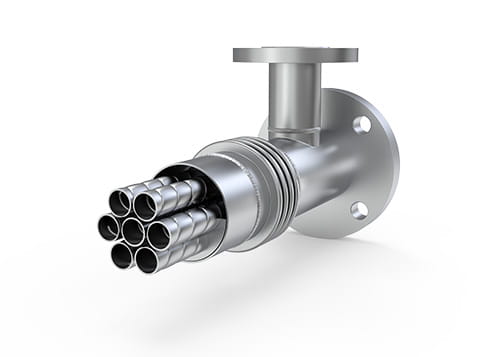
Industrial / Heavy Duty
Tube-in-Tube Heat Exchangers
- Abrasion & Corrosion Resistant
- Handles High Solids & Fibrous Media
- Easy Cleaning & Tube Access
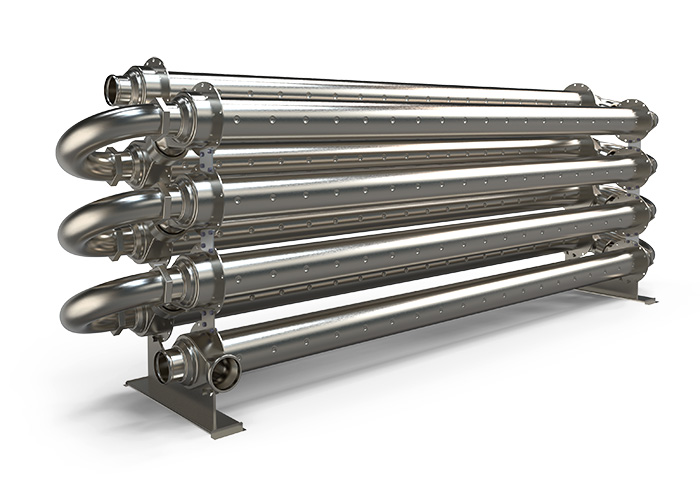
The Benefits of Tube-in-Tube Heat Exchangers for Solids-Containing Applications
Tube-in-tube heat exchangers are unmatched for processing products with solids, particulates, fibers, or high dry solids content. The simple concentric geometry provides large, unobstructed annular and inner flow passages that eliminate bridging, plugging, and dead zones common in plate, shell-and-tube, or scraped-surface designs.
Low shear and controlled velocity protect delicate particulates — fruit pieces, vegetable chunks, hop solids, grain fragments, or sludge flocs — preventing breakage, smearing, or loss of texture. True counterflow ensures uniform temperature profiles, high thermal efficiency, and minimal hot/cold spots that could cause burning-on or under-processing.
Sanitary versions deliver full hygienic performance with polished 316L surfaces, 3-A/EHEDG/FDA compliance, complete drainability, and effective CIP/SIP capability — critical for food, beverage, and brewing applications. Industrial versions use abrasion-resistant materials (duplex, super duplex, hardened alloys) and thicker walls to withstand erosive slurries, fibrous waste streams, and high-solids media with long service life.
Modular construction allows easy scaling and retrofitting. Optional enhancements — corrugated or dimpled tubes — boost turbulence for viscous or fouling-prone streams without narrowing flow paths. Mechanical cleaning access simplifies maintenance when CIP is insufficient.
These exchangers reduce fouling, extend run times, lower energy use through regeneration, minimize product damage, and ensure consistent quality. Proven worldwide in fruit processing, brewing wort cooling, sludge heating, soup/sauce lines, and waste treatment, tube-in-tube heat exchangers provide the most reliable, gentle, and clog-resistant solution for solids-containing applications.