
1-805-484-2992
Quotes - Engineering - SalesRegistration turns a stamp into a record
What the NB number adds on top of the U stamp
The ASME stamp says a tube-in-tube unit was built to Section VIII. National Board registration files the proof. The completed ASME data report, signed by the Authorized Inspector, is filed with the National Board of Boiler and Pressure Vessel Inspectors, and the unit's nameplate carries an NB number. Anyone holding that number can later obtain a copy of the report, even if the original paperwork has long since gone missing in the plant.
The reason is practical. Many states, provinces and cities that regulate pressure vessels require registration before a unit goes into service, and their inspectors look for the NB number at installation. Insurers that inspect pressure equipment look for it too. A stamped but unregistered exchanger is still code-built, but in those jurisdictions it can sit on the floor while someone tries to prove what it is.
Registration is settled when the order is placed. It is done with the data report while the unit is being built, and the nameplate is stamped then. Registering an older vessel afterward is difficult and sometimes impossible, so if there is any chance the unit will go to a regulated site, or be moved to one later, put NB registration on the purchase order.
Request a Quote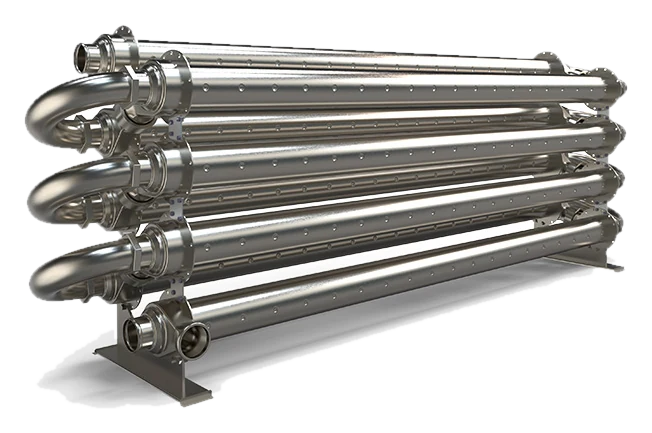
The registration number the National Board assigns to a code-stamped vessel, stamped on its nameplate and tied to the signed data report kept on file.
What registration covers on a tube-in-tube
Registration sits on top of the ASME stamp rather than replacing any of it. These are the pieces it adds or depends on.
| Item | Detail |
| Prerequisite | ASME Section VIII construction with the U stamp applied |
| Inspector | Authorized Inspector holding a National Board commission |
| Document filed | ASME data report, signed and registered |
| Nameplate | NB number added beside the U stamp, serial and ratings |
| Both chambers | Product and service sides recorded on the one report |
| Who checks it | Jurisdictional inspectors and pressure-equipment insurers |
| Later work | Repairs and alterations under the National Board Inspection Code |
| Record life | Retrievable for as long as the unit stays in service |
Jurisdictions that ask for it
Pressure-vessel rules are set locally. Many states and provinces, and some cities, adopt the ASME code by law and require National Board registration for vessels installed within their borders, often with an installation inspection and a certificate to operate. The rules differ on size, pressure and fluid exemptions. Tell us where the exchanger will be installed and registration goes on the order from the start.
Skids that ship elsewhere
OEM skid builders feel this most. A pasteurizer or heating skid assembled in one state and shipped to another must satisfy the rules at its destination, not where it was put together. Specifying NB registration on every coded exchanger on the skid removes one recurring reason for a site inspector to hold up commissioning.
Insurance and audits
Insurers that cover boilers and pressure vessels inspect on a schedule and want to see the nameplate and the registered report. An audit that finds a coded vessel without traceable paperwork turns into a records hunt. With registration, the report can be retrieved from the National Board by number, which closes the question in an afternoon rather than weeks.
Relocation and rerating
Plants move equipment. A tube-in-tube cooler that leaves one line for another plant, or is asked to run at a different temperature, needs its original design data. The registered report keeps that data available. Any rerating or alteration then follows the National Board Inspection Code, starting from a record everyone can trust.
Ordering a registered exchanger
Information to put on the order
State that National Board registration is required, give the installation location, and list any owner or insurer documents you need copies of. If the unit is part of a skid, say where the skid ships. We confirm registration on the quote and supply copies of the registered data report with the unit.
- NB registration required: yes or no, on the purchase order
- Installation state or province, and any city with its own rules
- Copies of the data report for your files and your insurer
What registration does not change
Registration adds no thickness, no extra test and no change to the design. The unit is built and tested exactly as it would be under the stamp alone; what differs is that the signed data report is filed and the nameplate carries one more number. The added cost is mostly paperwork, which makes it easy to justify whenever there is doubt about where the unit may end up.
Call and talk it through with an engineer: 1-805-484-2992
National Board registration questions
No. The U stamp shows the unit was built and inspected to ASME Section VIII. Registration files that unit's signed data report with the National Board and adds an NB number to the nameplate. A unit can carry the stamp without being registered, but it cannot be registered without the stamp.
Plan on no. If an unregistered unit is already on site, the first call goes to the jurisdiction, which decides whether it can enter service at all and on what conditions; some will accept it after inspection and review of the data report, others will not. Putting registration on the order avoids that conversation.
The inspector reads the NB number and serial from the nameplate and can obtain the registered data report from the National Board. That report shows materials, thicknesses, test pressures and the design conditions of each chamber, so it can be compared with how the unit is actually being run.
Only if it is code-stamped and the site or your insurer requires it. Many small low-pressure sanitary units fall outside ASME scope and are never registered. Where the jacket runs on steam or the plant has a blanket rule for pressure equipment, ordering registration is usually the safer choice.
Related

Sizing & Selection
3-A
3-A sanitary standards for tube-in-tube heat exchangers: product-contact finish, drainability, cleanability, materials, elastomers and the 3-A symbol.
+ Learn More
Sizing & Selection
Sanitary Design
Hygienic tube-in-tube heat exchangers for plants that need sanitary design but not 3-A: welds, tri-clamp joints, drainage, dead legs, finish, CIP and SIP.
+ Learn More
Sizing & Selection
ASME
ASME Section VIII tube-in-tube and double pipe heat exchangers: when a U stamp applies, MAWP, the hydrostatic test, data reports and which side is coded.
+ Learn More
