
1-805-484-2992
Quotes - Engineering - SalesLow-acid products on their way to an aseptic filler
Soups, sauces, puddings, nutritional drinks and baby food
Aseptic packaging lets a low-acid food sit on a shelf without refrigeration, but only if all of it has been commercially sterilized and then kept sterile until the package is sealed. Products with a pH above 4.6 fall into this group: cheese sauce, cream soups, vegetable soups with pieces, puddings, nutritional and medical drinks, plant-based beverages and vegetable baby foods. Each must be heated to sterilizing temperature, held, cooled and delivered to the filler without contact with unsterile air or equipment.
The tube-in-tube suits this service on three counts. Round tubes carry the pressure needed to keep product from boiling at sterilizing temperature. A welded product path has no gaskets for bacteria to shelter behind once it has been sterilized. And a full bore lets pieces through heater, hold and cooler alike, which is why particulate aseptic lines are tubular almost by default.
This page covers the product line and the equipment on it. The thermal design itself, including hold tube sizing and lethality, sits on the sterilization process page and is not repeated here.
Request a Quote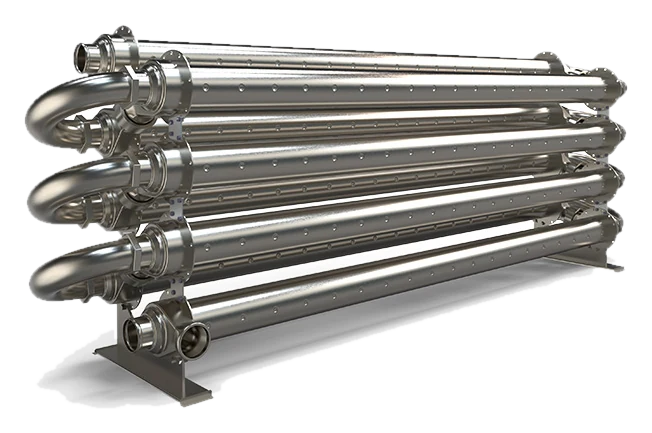
Everything after the heater must stay sterile
Cooling sections, piping and the filler inlet are all part of the sterile zone. The product side is sterilized before production starts and run under positive pressure so nothing from outside can leak in.
Aseptic product lines
Particulate foods
- Vegetable soups with diced pieces
- Pasta sauces and meat ragu
- Baby food with soft pieces
- Rice and grain desserts
Smooth low-acid
- Cheese sauce for foodservice
- Puddings and custards
- Cream soups and gravies
- Nutritional and medical drinks
Drinks and bases
- Oat and soy drinks
- Dairy-free coffee creamers
- Coconut milk and cream
- Low-acid vegetable juices
Designs that suit an aseptic line
Sterile service narrows the field to welded, drainable product paths; particle size and product thickness then pick the geometry within that group.
| PRODUCT / DUTY | DESIGN | WHY IT FITS |
| Soup with diced vegetables | Tube-in-Tube | A full bore carries pieces through heater, hold and cooler without the edges a plate or tubesheet presents |
| Smooth pudding or cheese sauce | Triple-Tube | Heating from both sides of a thin layer shortens the time a thick product spends coming up to temperature |
| Plant-based drink | Multi-Tube | With no pieces to bridge, a bundle gives the surface for high flow in a shorter bank |
| Pilot or small-batch aseptic skid | Ultra-Coil | A coil keeps hold-up volume low, cutting product lost at start-up and changeover, for fine products only |
Heating, holding and aseptic cooling with particulates
Coming up to temperature. Low-acid aseptic products are commonly heated somewhere in the range of 250 F to 300 F, the exact figure set by the product, its particle size and the process authority's schedule. At those temperatures the product side must run well above the vapor pressure of water so nothing flashes or boils, and heater, hold and cooler all carry that pressure. Heating is usually staged, with regeneration from outgoing product first and pressurized hot water after, so the wall never runs far above the product and fouling builds slowly.
Particles and the hold. The center of the largest particle must receive the scheduled treatment, and the liquid around it gets there first. That is why particulate processes run longer holds at somewhat lower temperatures than a smooth product would. The calculation belongs to the process authority and to our sterilization page, but the equipment consequence is simple: the bore must pass the largest piece through every section, with nowhere for it to stop.
Aseptic cooling. After the hold, product is cooled to filling temperature, often well below 100 F, entirely inside the sterile zone. The cooler sees the thickest product of the whole line at it's coldest point, so pressure drop peaks there, while the back pressure the hold needs must still be kept. Tempered water usually takes the first stage on the jacket side, with chilled water or glycol finishing the job.
Call and talk it through with an engineer: 1-805-484-2992
Keeping the product side sterile
Sterilizing in place
Before production, the product path from heater to filler is sterilized with pressurized hot water or steam, commonly at 250 F or above for a set time, with temperature recorded at the coldest point of the circuit. A drainable, welded tube bank reaches that temperature everywhere together, because it has no dead legs or pockets where condensate gathers and stays cool.
Pressure and leak direction
Sterile product should always run at higher pressure than the utility in the jacket, so a pinhole would push product out rather than let unsterile water in. That differential is set at design and watched in operation. Welded construction removes gaskets between product and service, and the tri-clamp joints sit at the ends of the bank where they can be inspected.
Run length and fouling
Aseptic lines stop for an intermediate clean when fouling raises pressure drop or pulls down the outlet temperature, and every stop costs a full re-sterilization. Protein and starch products foul fastest in the final heating section. Holding the heating medium only modestly above the product, and keeping velocity up in that section, are the two levers that lengthen a run.
Documents for the line
Aseptic lines are reviewed by a process authority, and in the United States low-acid processes are filed with the regulator. The exchanger's part is clear documentation: materials, surface finish, pressure ratings, hydrostatic test records and drawings showing drain points and instrument connections. Ask for that package with the quote so it is part of the order.
Questions on aseptic particulate lines
Yes, and on an aseptic line it must. CIP removes soil after a run; SIP then sterilizes the clean product path before the next one starts. The unit is rated for the SIP temperature and the pressure that goes with it, and drained low points make sure no pool of condensate sits below sterilizing temperature.
Often, particularly where the drink carries fiber or protein that fouls a plate. Indirect heating in a full bore gives longer runs on oat and soy bases, which build deposits in the final heating section. Smooth, low-fiber drinks can run on plate UHT units, so the choice depends on the recipe and the run length the plant needs.
Product that did not receive the scheduled treatment is diverted, and the sterile zone downstream is treated as compromised. The line is usually cleaned and re-sterilized before production restarts. The exchanger's job is to make that rare: stable heating with enough margin, fouling held back, and sensors placed where they read the true product temperature.
Related
Sanitary
Dairy
Tube-in-tube heat exchangers for dairy: stirred yogurt after the break, puddings, cheese sauce, fruit preparations and high-solids milk concentrates.
+ Learn More
Sanitary
Soups & Prepared Foods
Prepared food heat exchangers for soups, chili, stews and ready meals with pieces: cook, hold and cool beans, vegetables and meat without breaking them.
+ Learn More
Sanitary
Foods with Solids
Heat exchangers for particulates in food: particle size against the bore, solids fraction, settling, fragile pieces and heat reaching the core of a piece.
+ Learn More