
1-805-484-2992
Quotes - Engineering - SalesSlurries & Particulates with Tube-in-Tube Heat Exchangers
Tube-in-tube heat exchangers are specifically engineered for slurries and particulate-laden fluids. The wide, unobstructed annular and inner passages handle high solids concentrations (up to 40–60% by weight), abrasive particles, and variable particle sizes without bridging, settling, or plugging — while providing excellent counterflow heat transfer and low shear.
Typical Applications
- Mining & Minerals: Heating/cooling of ore slurries, tailings, lime slurries, and mineral suspensions.
- Chemical Processing: Temperature control of pigment pastes, catalyst slurries, polymer suspensions, and abrasive chemical mixtures.
- Paper & Pulp: Heating black liquor, starch slurries, filler suspensions, and coating formulations with particulates.
- Ceramics & Glass: Thermal treatment of clay slips, glaze slurries, and abrasive ceramic suspensions.
- Energy & Power: Cooling coal-water slurries, ash slurries, and flue gas desulfurization (FGD) gypsum slurries.
- Other: Drilling muds, paint/pigment dispersions, battery electrode slurries, and high-solids chemical reactions.
Industrial Slurries
Tube-in-Tube Heat Exchangers
- Abrasion-Resistant Materials (Duplex, Hardened Alloys)
- High Solids Capacity
- Low Velocity Settling Prevention
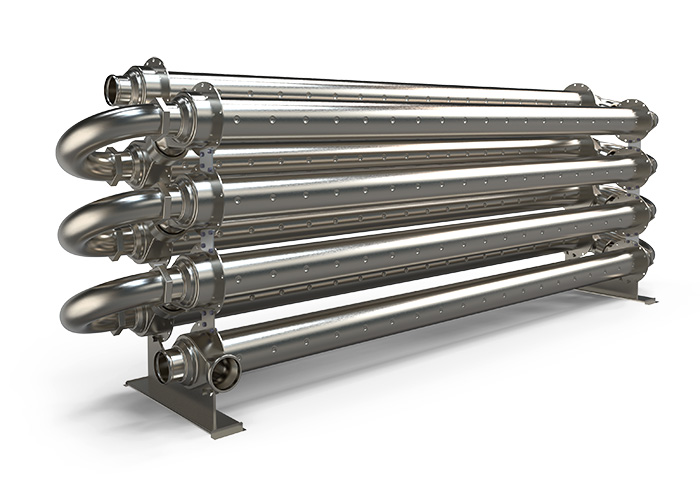
Heavy Duty / Abrasive
Tube-in-Tube Heat Exchangers
- Thick-Wall Tubing
- Erosion & Corrosion Resistance
- Easy Tube Replacement
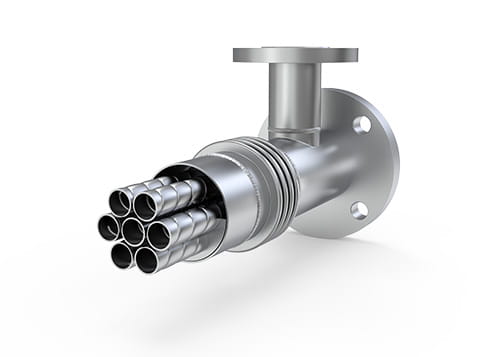
Advantages for Slurries & Particulates
Tube-in-tube heat exchangers are the most reliable solution for slurries and particulate fluids due to their large, straight-through flow paths that prevent settling, bridging, or blockage — even at high solids loadings and variable particle sizes.
Low product-side velocity reduces erosion while maintaining suspension; true counterflow provides high thermal efficiency and uniform heating/cooling without hot spots that could cause caking or scaling. Minimal shear preserves particle integrity in sensitive suspensions.
Heavy-duty construction uses abrasion-resistant alloys (duplex, super duplex, hardened 316L, titanium, ceramics-lined options) and thicker tubes to withstand erosive wear from sand, ore, pigments, or catalysts. Optional enhancements like rifled or dimpled tubes improve turbulence for heat transfer without restricting flow.
Modular design supports easy scaling, retrofitting, and tube replacement. Mechanical cleaning access handles severe fouling when CIP is insufficient. Low fouling tendency extends run times; regeneration options recover energy in continuous processes.
Proven in mining tailings, FGD gypsum, pigment pastes, coal slurries, ceramic slips, and chemical suspensions worldwide, these exchangers deliver long service life, reduced maintenance, lower downtime, and consistent performance in abrasive, high-solids environments.