
1-805-484-2992
Quotes - Engineering - SalesPasteurizing what a plate pack cannot pass
Heat, hold and cool for viscous and particulate products
A pasteurizer for chunky salsa, a fruit preparation or a pulpy nectar has three jobs. It brings every part of the product to the process temperature, keeps it there for the scheduled time, and brings it back down before color and flavor pay for the extra heat. With diced fruit, seeds, pulp, or a product thick enough to run laminar, the liquid reaches temperature well before the inside of each piece does.
Tube-in-tube puts all three sections in one bank of hairpins. Hot water in the annulus heats the product, an insulated hold tube provides the residence time, and tower water, chilled water or glycol cools it in counterflow. Each section offers a full-bore product path with no contact points, so pieces pass through without being snagged, crushed or stranded in a corner.
Most of the pasteurizing we size is for acid and acidified foods - fruit, tomato, salsas, dressings, many juices - where a mild heat treatment plus hot fill or refrigerated distribution is the preservation step. Low-acid products going to shelf-stable packs need a sterilization schedule instead. Clear, pulp-free juices usually pasteurize more cheaply on a plate; the products on this page are the ones a plate pack turns away.
Request a Quote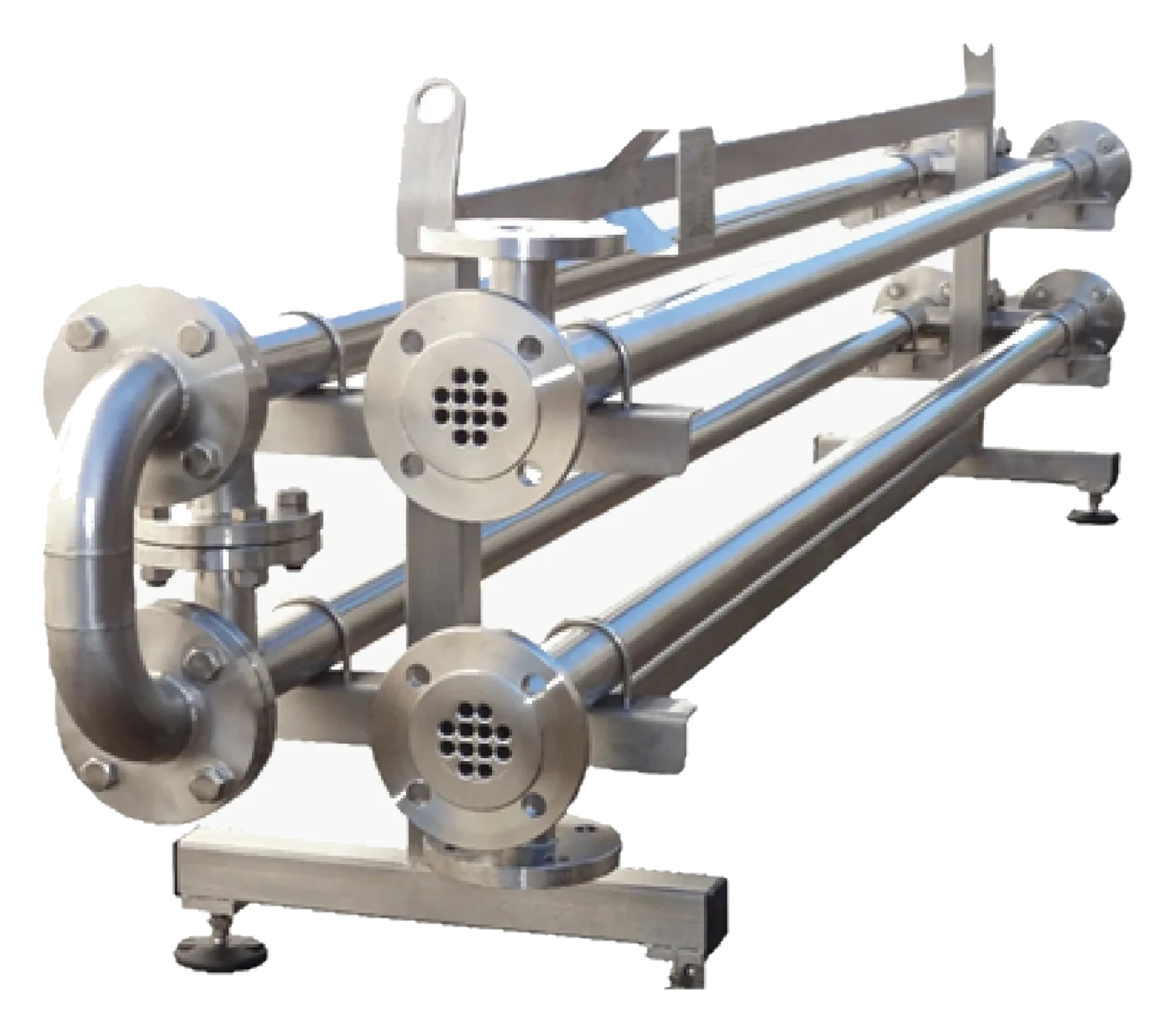
The spot in the product that reaches process temperature last - usually the center of the largest piece - and the point the pasteurization schedule is written for, not the liquid around it.
Sections of a particulate pasteurizer
What each section does and what decides its size; one set of product data sizes all of them.
| Section | Detail |
| Regeneration | Hot treated product preheats cold raw product, directly or through a water loop |
| Heating | Hot water in the annulus, kept a modest margin above the product target |
| Hold tube | Insulated, rising in the direction of flow, length set by flow rate and hold time |
| Diversion point | Product short of temperature at the hold exit is returned, never filled |
| Cooling | Staged tower water then chilled water or glycol, in true counterflow |
| Cleaning | CIP through the full product path; every section fully drainable |
| Piece size | Largest dimension in inches, plus shape, firmness and fraction by volume |
Why plate packs fail here
A gasketed plate pack runs product through narrow channels pressed into corrugated sheet, with metal-to-metal contact points across every plate. Pulp collects on those points, fibers wrap around them and diced pieces either bridge the port or break apart going through. Pressure drop creeps up over the run, flow falls off, and the fouled plates pass less heat, so product reaches the hold cooler than it did at start-up. A pasteurizer that met its schedule at start-up can be short of it by the end of the shift.
Pieces set the hold time
Heat reaches the center of a piece by conduction alone, and conduction time grows with the square of the piece size. A 3/4" cube of peach needs roughly four times as long to heat through as a 3/8" cube. The syrup around it is at temperature long before the core is. A hold sized on liquid temperature passes the thermometer check at the hold exit and still leaves the largest pieces under-processed.
Regeneration with pieces in the flow
Product-to-product regeneration recovers most of the heat, but then both sides of that section carry product. Raw product with pieces runs in the inner tube; the treated product returns through the annulus, which needs a gap wide enough for the same pieces. Where that gap would be too wide to transfer heat well, an intermediate water loop does the job instead: hot product heats water, the water preheats raw product, and each product keeps its own full-bore tube.
Stopping the cook on time
Every second the product spends hot after the hold adds heat treatment nobody asked for - softer pieces, darker color, a cooked note in the flavor. Hot-fill products leave the pasteurizer near fill temperature and finish cooling in the container. Cold-fill and refrigerated products need the cooling section designed together with the hold, sized to bring the product down quickly once the schedule has been met.
Building a pasteurizer around the product
Start from the largest piece, not the average
Send the worst case. The hold tube and heating section are sized for the biggest, densest piece the line will ever see, because that is the piece whose core heats last. A specification that lists an average dice size, or leaves out the occasional whole berry or oversized chunk, produces a pasteurizer that is correct on paper and short in practice. Many processors prove their schedule with a validation study; the exchanger has to match the flow rate, temperatures and piece size used in that study.
Velocity, settling and piece survival
Pieces denser than the carrier settle in a horizontal run if the velocity is too low, and a settled bed spends far longer in the hold than the schedule assumes. Too high a velocity has the opposite cost: pieces tumble against the wall and lose their edges. The design point sits between the two, with a product bore several times the largest piece dimension and long-radius U-bends so pieces turn without striking a sharp corner. A thick carrier keeps pieces suspended at lower velocity than a thin one, which is one more reason the viscosity at process temperture matters.
What a pasteurizer quote should carry
List the product and everything in it, the flow rate, inlet temperature, the process temperature and hold time from your schedule, the fill or outlet temperature, pH, viscosity at both ends of the temperature range, and the largest piece with its shape and firmness. Name the hot and cold utilities on site. If the viscosity is unknown, a sample test fills the gap before sizing.
Call and talk it through with an engineer: 1-805-484-2992
Pasteurizing chunky products
Usually yes, provided the product bore is several times the largest berry and the velocity is low enough that the fruit is not battered against the wall. Whole soft fruit is the most fragile case, so we size it on the actual fruit, not a nominal dimension. Send a sample or a photo with a ruler in frame, along with how firm the fruit is at process temperature.
Insulated, never heated. Adding heat inside the hold would mask a shortfall from the heating section and make the reading at the hold exit meaningless as a control point. The hold is insulated, rises gently in the direction of flow to purge air, and ends at the sensor that decides whether product goes forward or is diverted back for reprocessing.
It depends on run length and utility cost more than on size. Regeneration adds hairpins and pressure drop, and with pieces in both streams it may need a water loop, which adds a pump. On a long daily run it usually pays back through lower steam and chilled water use. On short runs with frequent changeovers, a simpler heat-hold-cool layout is often the better buy.
It can, if it is sized for the more demanding product on each count. The chunky product sets the bore and the hold length, while the smoother, thicker product may set the pressure drop. A unit sized only for the smooth sauce will usually have too small a bore for pieces.
Related

Sizing & Selection
Sterilization
Thermal design for tube-in-tube UHT sterilizers: heating to 275-300 F, hold tube length, residence-time distribution, F0 and SIP of the product side.
+ Learn More
Sizing & Selection
High-Pressure Fluids
Tube-in-tube and double pipe exchangers for high-pressure fluids - supercritical CO2, gas coolers, hydraulic oil, hot water - to 1500+ psi, ASME built.
+ Learn More
Sizing & Selection
Heating
Tube-in-tube heat exchangers for heating: steam, hot water or thermal oil in the annulus, the wall temperature kept in check against burn-on, regeneration.
+ Learn More
