
1-805-484-2992
Quotes - Engineering - SalesSmall oilfield duties at wellstream pressure
Oil and gas facilities are full of heat duties that are too small for a large shell-and-tube and too hot, dirty or pressurized for a plate pack. Produced water arrives hot, salty and carrying sand and oil. Heavy crude has to be warmed before it will separate or desalt. Amine and glycol loops trade heat between lean and rich solvent around the clock, and condensate and high-pressure gas need cooling at separator pressure. These are the duties where a tube-in-tube or double pipe unit earns its place on the skid.
The reason is mechanical before it is thermal. A small-diameter inner tube holds wellstream pressure on a moderate wall, the jacket carries the lower-pressure utility, and welded construction leaves no large bolted girth flange to leak. Sand and oil pass a single full-bore path rather than settling in baffle windows, and the hairpin arrangement absorbs expansion between hot and cold legs. Sections bolt together, so capacity can grow as a field's water cut rises.
Material choice drives the rest of the design. Carbon steel suits sweet hydrocarbon service and most glycol and lean amine duties. Produced water, with its chlorides and dissolved gases, usually moves the wetted tube to 2205 duplex. Wet hydrogen sulfide brings its own rules on hardness and material qualification, and the specification has to say so before anything is quoted.
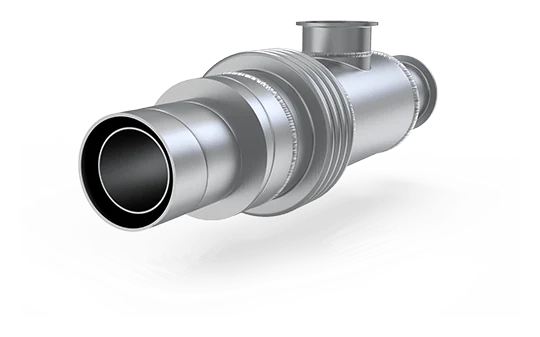
Tube-in-tube
- Wellstream pressure in a small-bore tube
- No large bolted shell flange to seal
- Sand and oil pass a single path
Shell-and-tube
- Thick shell and heavy flanges at pressure
- Sand settles behind baffles
- Bundle pulled to clear scale and solids
Oil and gas service matrix
Typical streams and the decision each one forces. Pressures, temperatures and chemistry come from your process data; the table shows what we look at first.
| Stream | Detail |
| Produced water | Hot, chloride-rich, often with sand and oil; wetted tube usually 2205 duplex |
| Crude preheat | Heavy crude warmed to cut viscosity before separation or desalting |
| Lean/rich amine | Carbon steel or stainless set by temperature and acid-gas loading |
| Glycol dehydration | Lean-rich glycol exchange and lean glycol cooling |
| Condensate | Cooling and stabilization at separator pressure |
| High-pressure gas | Gas in the inner tube, coolant in the annulus |
| Sour service | Materials and hardness qualified for wet hydrogen sulfide |
| Code | ASME Section VIII, U stamp, National Board registration |
Produced water and duplex
Produced water is the duty that retires 316L. It runs hot, carries far more chloride than seawater in many basins, and often holds dissolved carbon dioxide and hydrogen sulfide. In that mix 316L is at risk of chloride stress-corrosion cracking and pitting under deposits. 2205 duplex resists both far better and its higher strength allows a thinner wall at pressure, which offsets much of its cost.
- Wetted tube in 2205 duplex, jacket often carbon steel
- Titanium where chlorides and temperature run higher still
- Sand allowance at every return bend
Skid and site constraints
Oilfield units are mounted on skids, platforms and pipe racks where space and weight are tight and the duty changes over the life of the field. Tube-in-tube sections stack into a compact bank, and adding sections later is a piping job rather than a new exchanger. Flanged double pipe sections can be opened in place for mechanical cleaning, which matters at remote sites without heavy lifting equipment.
- Stacked hairpin bank on a small footprint
- Sections added as water cut climbs
- Opened in place, no bundle extraction space
- Light enough for rack or skid mounting
Applying tube-in-tube on oil and gas duties
Crude, condensate and wax
Heavy crude is a viscosity problem first. Warming it lowers viscosity sharply, which helps separation, desalting and pumping, and the duty is usually laminar in the tube at the cold end. On cooling duties for waxy crude or condensate, the wall must stay above the wax appearance temperature or wax lays down on the tube and heat transfer collapses; that sets the coolant temperature, not just the outlet target. Condensate cooling at separator pressure is a clean, high-pressure duty where the inner tube carries the hydrocarbon and the jacket a modest-pressure coolant.
Amine and glycol loops
Lean-rich amine exchangers recover heat between the regenerator and the absorber, and the rich side carries dissolved acid gas that flashes and corrodes if it is heated to far or moved too fast in carbon steel. Velocity limits and, at the hot end, stainless tubes are the usual answers. Glycol dehydration units use the same lean-rich exchange plus a lean glycol cooler, typically on carbon steel with clean service. Both loops run continuously, so a counterflow bank with a close approach recovers heat every hour of the year.
Sour service, pressure and paperwork
Wet hydrogen sulfide calls for materials and welds qualified for sulfide stress cracking, with hardness limits on base metal, welds and heat-affected zones. That requirement has to be in the specification from the first inquiry, because it changes material, weld procedures and testing. Pressure units are built to ASME Section VIII with a U stamp and National Board registration, and hydrostatically tested above design pressure. Send the fluid analysis, pressures, temperatures, flows and the sour-service requirement your company applies.
Call and talk it through with an engineer: 1-805-484-2992
Oilfield duty questions
Only for cool, low-chloride water, and that is rare. Most produced water is hot and salty enough that 316L risks chloride stress-corrosion cracking, which can fail a tube with little warning. 2205 duplex is the usual floor for the wetted surface. If the water analysis shows very high chlorides at high temperature, titanium is worth pricing alongside duplex before deciding.
The industrial line runs to 1500+ psi, with the high-pressure stream in the inner tube where the small diameter carries pressure efficiently. Higher pressures are a matter of wall thickness, material and closure design rather than a different product. Give us the design pressure and the shut-in pressure the unit could see, and we size the wall to the code for both.
Keep velocity up so sand stays suspended, and put wear allowance at the return bends where sand strikes the outer wall. Long-radius returns spread that wear over a larger area. A desander upstream still helps, but the exchanger should tolerate the sand that passes it, because there is always some. Flanged returns allow the bends to be inspected at turnarounds.
On small duties at high pressure, a shell-and-tube spends most of its cost on a thick shell, tubesheets and bolted closures that a double pipe section does not need. Double pipe also gives true counterflow, so a temperature cross is possible in one bank. Once the duty grows large and clean, shell-and-tube becomes the cheaper buy per square foot, and we will tell you when that point arrives.
Related
Industrial
Hot Effluent Heat Recovery
Recover heat from hot, dirty effluent to preheat clean water: tube-in-tube heat recovery exchangers with a cleanable dirty side and true counterflow.
+ Learn More
Industrial
Pulp Mill Liquors
Tube-in-tube heat exchangers for black, green and white liquor and digester circulation heating: hot caustic service, scaling and duplex materials.
+ Learn More
Industrial
Resins & Heavy Viscous
Tube-in-tube heat exchangers for resins, adhesives, inks, greases and bitumen emulsions: heating to pump, thermal oil service and laminar-flow sizing.
+ Learn More