
1-805-484-2992
Quotes - Engineering - SalesSizing around the piece, not the liquid
Four particle properties set the design before flow rate does
Every food with solids raises the same four questions, whatever the recipe. How big is the largest piece compared with the bore it must pass through? What share of the volume is pieces? Will those pieces stay suspended or settle when the flow slows? And how long does heat take to reach the center of the biggest one? The answers fix the tube diameter, the velocity and the length well before the heat duty in Btu per hour does.
Plate exchangers fail the first question outright, and many shell-and-tube units fail it at the tubesheet, where a piece meets each tube entrance at a sharp edge. A tube-in-tube has one bore from end to end with long-radius returns, so the only hard constraint is diameter. That is why particulate products of every kind, from salsa and pie filling to diced fruit in syrup, run in tubes.
This page deals with the particle question on its own terms. The pages for soups, fruit and vegetables, dairy and beverages apply the same reasoning to their particular recipes, and the aseptic page carries it into sterile service.
Request a Quote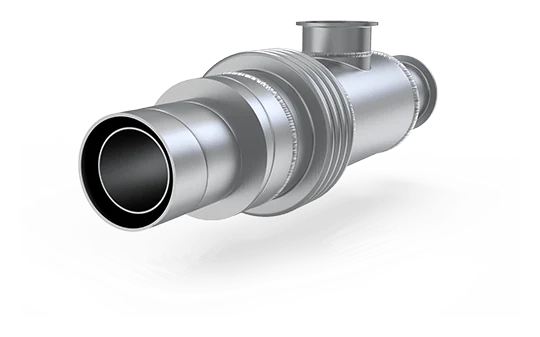
Heating time grows with the square of piece size
Heat enters a solid piece only by conduction, so the time for its center to reach temperature rises with the square of its thickness. Going from a 3/8" dice to a 3/4" dice roughly quadruples it.
What we ask about the pieces
Size and shape
- Largest dimension, not the average dice size
- Cubes, slices, strands or whole berries
- Whether pieces swell or soften in process
Load and density
- Solids as a share of total volume
- Piece density compared with the carrier
- Carrier viscosity at the coldest point
Fragility
- Firm, tender or skin-on pieces
- How much breakage the product tolerates
- Where pieces join the line
Bore and geometry by particle type
Large and soft pieces need a single full bore; small, firm particles open the door to designs with more surface per foot of length.
| PRODUCT / DUTY | DESIGN | WHY IT FITS |
| Large dice, whole berries, beans | Tube-in-Tube | One full bore sized well above the largest piece, with long-radius returns and no internal edges |
| Seeds, fine pulp, small particles | Multi-Tube | Particles far smaller than each tube pass freely, and the bundle adds surface per foot |
| Small firm pieces in a heavy base | Triple-Tube | Heats from both sides of the annulus as long as the gap stays well wider than the particles |
| Fine particulates on a compact skid | Ultra-Coil | A coiled layout for small particles where floor space is tight; not for large or fragile pieces |
Three checks every particulate design must pass
Size against the bore. A common rule of thumb keeps the largest piece well under half the bore, and nearer a third where pieces are irregular or travel in clusters. Two pieces meeting side by side in a return bend are what bridge a tube, rarely one piece alone. The dimension that counts is the largest one after any swelling, so a nominal 3/4" potato dice that has softened and grown in the kettle has to be measured as it actually arrives at the exchanger.
Solids fraction and settling. At a low solids load, pieces travel as individuals and the carrier liquid governs heat transfer. As the load climbs toward half the volume, pieces crowd each other, the mixture starts to act like a paste and pressure drop rises fast. Settling is the opposite risk: a dense piece in a thin carrier sinks to the bottom of a level tube at low velocity and slides instead of flowing, overcooking against the wall. Velocity, carrier viscosity and piece density together decide whether it happens.
Heat reaching the core. The carrier reaches setpoint by the end of the heater. A 3/8" cube follows behind it, and a 3/4" cube needs roughly four times as long as the smaller one. The design therefore holds product at temperature long enough for the slowest-heating piece, and for a cooked or pasteurized product the target is the center of that piece, not the liquid around it. Doubling the hold for safety softens every piece on the line, so the margin is set with care.
Call and talk it through with an engineer: 1-805-484-2992
Particles and the rest of the line
Fragile against firm pieces
Firm pieces such as carrot dice and beans tolerate ordinary velocity and pumping. Tender ones such as ripe peach, cooked pasta or blueberries break at the first sharp edge. For tender pieces, velocity sits near the low end of the window, returns use the largest practical radius and the pump is a slow positive displacement type. Breakage measured on a trial batch is a better guide than any rule.
Corrugated tubes and pieces
Corrugation raises the film coefficient of a viscous carrier, but it also reduces the clear diameter and gives a piece ridges to rub against. On products with soft or large pieces we keep the product tube smooth. Corrugation is worth considering only where the particles are small and firm and the carrier is thick enough to stay laminar in a plain tube.
Cleaning out particulates
Pieces lodge where velocity drops: at reducers, valves and the inlet of the exchanger. A uniform bore with matching clamp fittings removes most of those places. CIP flow is set above production flow so cleaning velocity clears seeds, skins and starch left in the bends, and a final drain proves nothing remains sitting in the bank.
Testing a particulate product
Viscosity of the carrier alone, measured across the process temperatures, plus a sieve or hand measurement of the pieces, is usualy enough to size the unit. Unusual mixtures, such as a product whose pieces absorb liquid and swell, may need a custom test agreed in advance so the design rests on what the line will really see.
Particle size and the bore
That is set by the bore you specify rather than by a fixed limit of the design. Product tubes come in larger diameters for large pieces, with the trade-off that a bigger bore needs more flow to keep velocity up and more length for the same duty. Tell us the largest piece and we size the tube around it.
Each tube in the bundle is small, and the flow divides among them at the inlet. If a piece or a cluster lodges in one tube, flow there slows, more pieces stack up behind it and that tube plugs while the others carry on. Overall pressure drop barely changes, so the blockage often goes unnoticed until cleaning.
Yes, if velocity is too low for the density diffrence between piece and carrier. Settled pieces slide along the bottom, overcook on the wall and can build a bed that narrows the bore. A thicker carrier holds pieces up better, which is why settling is a bigger risk in brine or thin broth than in a heavy gravy.
Strongly, once the pieces start to crowd one another. At low loads the carrier liquid dominates, but a mixture approaching half solids by volume behaves more like a paste and calls for a measured flow test or a conservative design. We base the pressure-drop estimate on the recipe at its highest solids load, never its average.
Related
Sanitary
Fruit & Vegetable
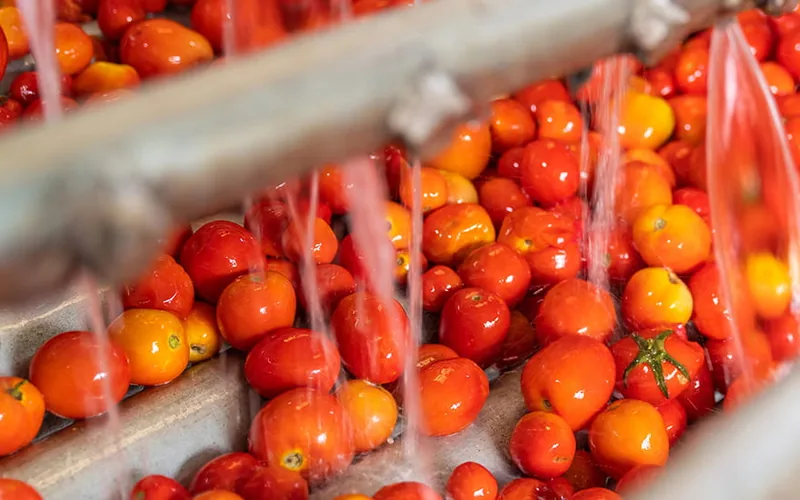
Fruit puree heat exchangers in tube-in-tube form for purees, fruit preparations, tomato hot break and vegetable purees: pulp passes, 316L takes the acid.
+ Learn More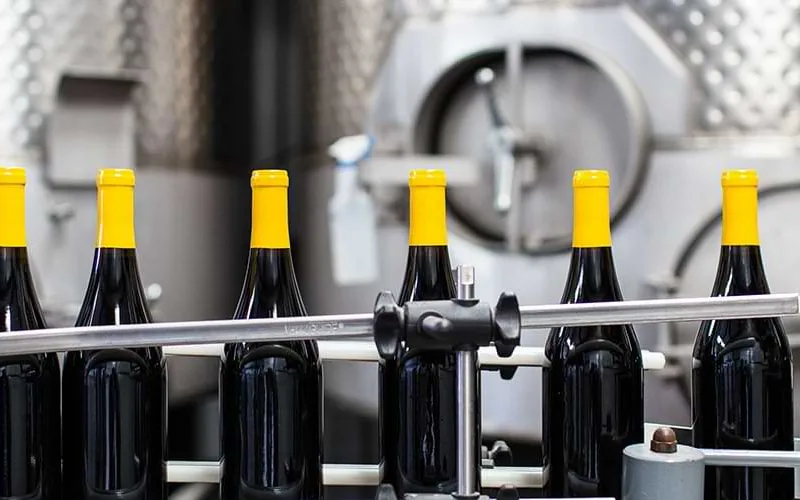
Sanitary
Beverages
Beverage heat exchangers in tube-in-tube form for pulpy juice, juice with sacs, smoothies, oat and plant-based drinks and concentrates, hot fill included.
+ Learn More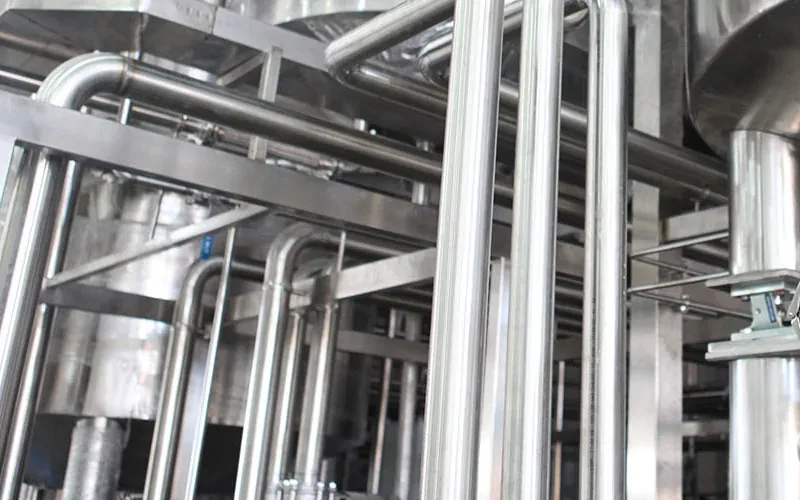
Sanitary
Aseptic & UHT Products
Aseptic heat exchangers in tube-in-tube form for UHT and low-acid foods with particulates: heating to sterilizing temperature, aseptic cooling and SIP.
+ Learn More
