
1-805-484-2992
Quotes - Engineering - SalesA bundle of product tubes in one jacket
A multi-tube unit places a bundle of smaller product tubes inside a single jacket tube. The product divides among them at an inlet header, travels the straight run in parallel and recombines at the far end before the next section or the outlet. The service fluid fills the jacket around the whole bundle and flows the opposite way. Several small tubes have more wall area than one large tube of the same flow area, so each foot of exchanger does more work.
That makes it the natural choice for products that are pumpable and fairly uniform: orange juice with pulp, tomato and vegetable juices, smoothies with fine fruit cells, creams, custard bases, plant-based drinks and sauces without chunks. Smaller tubes also mean a thinner product stream, so its center heats or cools sooner and the unit reaches a close approach in fewer sections than a single tube at the same flow.
The trade is passage size. A piece close to the diameter of one small tube can lodge at the bundle inlet, and once one piece hangs there others pile up behind it. Long fibers that drape across the inlet face do the same. If the product carries dices, slices or whole fruit, a single full-bore tube is the safer choice even though it needs more length.
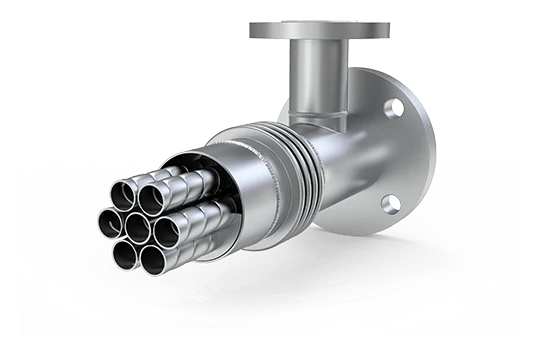
A bundle is only as good as the inlet that splits the product - an uneven split means some tubes overheat while others barely reach temperature.
Distribution and piece size decide whether a bundle works
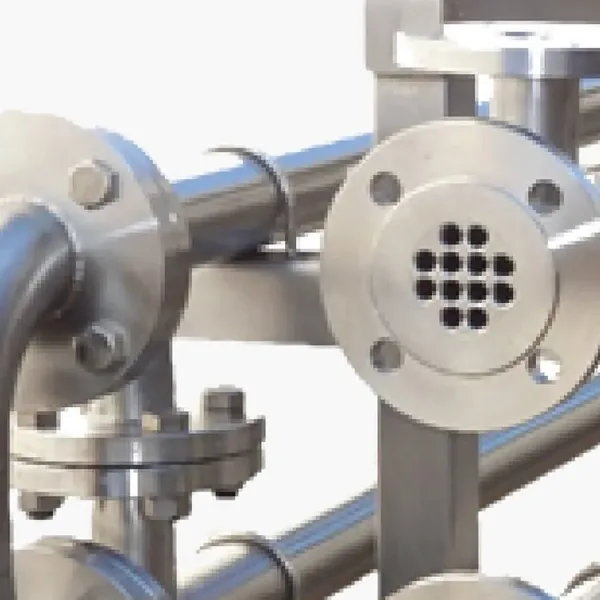
Capacity in a shorter frame
- More wall area per foot than one large tube
- Thinner product stream, faster center response
- Close approach in fewer sections
- Parallel tubes hold pressure drop in check
- Corrugated product tubes for laminar duty
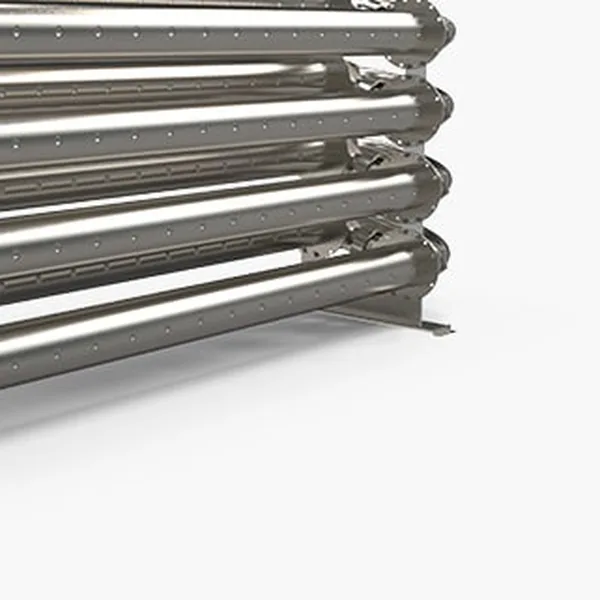
Built for smooth, pulpy product
- Juice pulp and fruit cells pass freely
- Gentle heating of creams and custard bases
- Polished 316L product tubes, built to 3-A
- Fully drainable, CIP and SIP ready
- Industrial bundles in duplex and higher alloys
Bundle Options




What sets a multi-tube unit apart
These are the parameters that separate a multi-tube unit from the single-tube design. Tube count and tube diameter are chosen together during sizing.
| Parameter | Detail |
| Product tubes | Several smaller tubes in parallel inside one jacket |
| Inlet and outlet | Header splits and recombines the product at each section |
| Best-fit products | Juices with pulp, smoothies, creams, smooth sauces, plant-based drinks |
| Solids limit | Fine particles and short fibers well below the small-tube bore |
| Service side | Fills the jacket around the bundle, in counterflow to the product |
| Tube surface | Smooth or corrugated; corrugation for thick product without pieces |
| Sanitary build | 316L or 304L, polished or electropolished, tri-clamp, 3-A, drainable |
| Industrial build | 316L, 2205 duplex, AL-6XN or titanium; flanged or threaded ends |
Getting a multi-tube bundle right
Why big pieces bridge
Bridging starts with one particle. A piece nearly as wide as a tube, or two pieces arriving together, catch on the entrance and partly block it. Flow through that tube drops, velocity falls, and the next pieces stop behind the first. Within a short run the tube is plugged, the remaining tubes carry the extra flow at higher pressure drop, and the product trapped in the plugged tube overcooks. Our sizing rule is simple: the smallest tube must pass the largest piece with room to spare, or the design changes.
Even distribution across the tubes
Every tube in the bundle has to see the same flow, or the outlet temperature becomes an average of over-processed and under-processed streams. A tube running slower then its neighbors holds product longer; a faster one shortchanges it. In cooling duty the effect feeds on itself: a slow tube cools further, its product thickens, and it slows again. Equal tube lengths, identical return paths and an inlet that does not favor the center tubes keep the split even.
- Equal tube lengths and identical return paths
- An inlet header that feeds outer and center tubes alike
- Viscosity checked at the cold end, where maldistribution grows
- Enough pressure drop per tube to force an even split
Cleaning a bundle
Several small tubes give a cleaning solution more wall to wet, and each tube needs enough velocity to scour it. CIP flow is therefore sized on the total flow area of the bundle rather than on one tube, and the supply pump must be able to deliver it. Sanitary builds are fully drainable so no rinse water or caustic stays behind. Where industrial deposits are hard, a bundle is harder to rod than one large tube, which is another reason heavy-fouling streams usually go single-tube.
- CIP flow sized on the total bundle flow area
- Every tube drained after rinse and caustic
- Header faces inspected for pulp caught between tubes
- Heavy-fouling industrial streams kept to a single bore
Multi-tube sizing questions
The pulp, cells and fibers need to be well below the bore of the smaller tubes, with room for two pieces arriving at once. Citrus pulp and fruit cells in a juice usually qualify. Diced fruit, vegetable pieces or long stringy fibers usually do not, and those go to a single full-bore tube instead.
Occasional is the dangerous word. A unit that handles fine pulp all week can be plugged by one batch carrying an oversize piece or a clump of fruit skin, and clearing a blocked small tube means stopping the line. If large pieces can appear at all, size for them or screen them out upstream.
Often, because a shorter unit needs less material and a smaller frame. But the headers add cost and the pump must overcome the pressure drop of the smaller tubes, so the saving is real only when the product suits the bundle. For a product with pieces, the cheaper bundle becomes the expensive one the first time it plugs.
Wall shear in a small tube is higher than in a large one at the same velocity, because the shear rate at the wall scales with velocity divided by diameter. For most creams, sauces and juices the difference does not matter. For a fragile emulsion or a product whose texture is set by shear, we check the wall shear rate against rheology data before committing to a bundle.
Yes. Corrugated product tubes raise the film coefficient for thicker product in laminar or transition flow, which can shorten the unit further. They also narrow the effective passage, so we use them for smooth creams and sauces and leave them out where pulp or fibers could catch on the corrugations.
Related
Heat Exchangers
Triple-Tube
Triple tube heat exchanger with product in the middle annulus, heated or cooled from both sides. For purees, pastes and fillings too thick for one tube.
+ Learn More
Heat Exchangers
Double Pipe
Double pipe heat exchanger in pipe sizes with flanged or threaded ends for high-pressure, small-to-medium duties, in carbon steel through titanium.
+ Learn More
Heat Exchangers
Concentric Tube
Concentric tube heat exchanger with coaxial channels: how the product side, annular gap and flow are chosen, including product in the annulus.
+ Learn More
